Quick answer
The phrase Chinese mythology goddess is useful for searching, but it can hide major differences. Nuwa belongs to creation and cosmic-repair traditions. Xiwangmu is an ancient and changing figure linked with immortality. Chang'e is associated with the moon and story variants about an elixir. Mazu stands at the center of a living coastal religious tradition. Guanyin is the Buddhist bodhisattva of compassion, often represented in female form in China, rather than simply a goddess from one mythological pantheon.
To identify a figure responsibly, ask four questions: What name or title appears in the source? What kind of source is it—a classical text, Buddhist image, local ritual, literary retelling, or modern adaptation? What date and place does the evidence belong to? Which attributes are actually visible? Those questions are more reliable than matching one symbol and assuming every female sacred figure has the same role.
Why “goddess” is an umbrella, not one fixed category
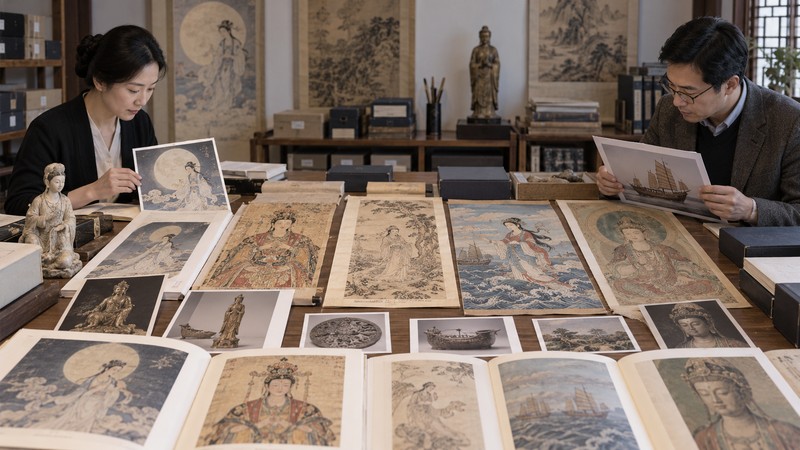
English-language summaries often arrange Chinese figures into a single family of gods and goddesses. Chinese religious and narrative history is less tidy. Mythic stories, state cults, local worship, Daoist traditions, Buddhist devotion, literature, theater, visual art, and modern media overlap without becoming one stable canon.
That is why the same English word may be applied to figures with different identities. A creator in an early story is not the same type of figure as a bodhisattva in Buddhism. A person remembered and worshipped in coastal communities is not best understood only as a character in a myth. A figure's role can also change across centuries, regions, texts, and images.
Use “goddess” as a starting label. Then name the tradition and source layer that support the specific claim.
Compare five figures at a glance
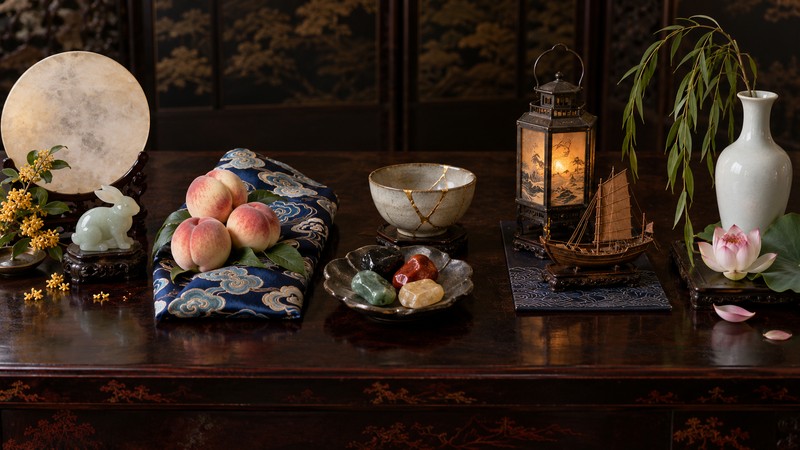
| Figure | A useful first description | Common clues | Important boundary |
|---|---|---|---|
| Nuwa (女娲) | mythic creator and repairer of cosmic damage in different traditions | colored stones, damaged sky, human creation, sometimes a serpentine body | creation and sky-repair accounts should not be forced into one seamless biography |
| Xiwangmu (西王母) | Queen Mother of the West, an ancient figure whose roles and imagery changed | western realm, immortals, peaches, celestial court | the familiar peach-banquet image is only one part of a long history |
| Chang'e (嫦娥) | moon figure whose ascent is connected with an elixir in varying stories | moon, rabbit, cassia, elixir | her motive and moral meaning change across versions |
| Mazu (妈祖) | maritime protector at the center of living coastal belief and custom | sea travel, temples, lanterns, processions, coastal communities | she should not be reduced to a fictional sea-goddess character |
| Guanyin (观音) | widely worshipped Buddhist bodhisattva of compassion | lotus, vase, willow branch, compassionate aid | “goddess of mercy” is a popular English label, but bodhisattva is more precise |
The symbolic clues are not an automatic identification system. Artists reuse motifs, objects acquire new meanings, and modern illustrations may combine details from several traditions.
Nuwa: creation and repairing the sky
Nuwa appears in traditions about creating humans and restoring a damaged cosmos. The British Museum's discussion of Nuwa in Chinese myth notes her serpentine representation and a creation story in which humans are formed from yellow clay. The Huainanzi, “Lan Ming Xun” describes Nüwa smelting stones of five colors to repair Heaven after cosmic disorder.
These episodes are often joined in modern summaries, but a reader should still ask where each detail comes from. Texts, commentaries, paintings, popular books, and contemporary animation may select different sequences and motives. The site's Nuwa in Chinese mythology guide maps creation, sky repair, and source variants, while Fuxi and Nuwa addresses their paired imagery.
When identifying Nuwa in art, a human upper body and snake-like lower body can be a clue, especially in paired images with Fuxi. It is still necessary to check the museum record or inscription rather than relying on the body form alone.
Xiwangmu: an ancient figure of the western realm
Xiwangmu, the Queen Mother of the West, should not be reduced to “the peach goddess.” The Metropolitan Museum of Art's essay on longevity in Chinese art describes stories about her celestial peach orchard, peaches that confer immortality, and banquets at which she served them. That evidence supports the peach-and-banquet layer; it does not by itself establish her full earlier textual or Han-period history.
Use the site's Queen Mother of the West guide for a fuller source boundary. In visual art, peaches, immortals, and a celestial court can support identification, but they do not prove that every woman holding a peach is Xiwangmu.
Chang'e: the moon and the problem of one “correct” version
Chang'e is associated with the moon and an elixir of immortality. In the Huainanzi, “Lan Ming Xun”, Yi obtains the drug from Xiwangmu and Chang'e steals it and flees to the moon. This textual witness connects Chang'e, Yi, Xiwangmu, the elixir, and the moon, but it does not supply all motives found in later retellings.
The Metropolitan Museum of Art identifies a Ming painting as The Moon Goddess Chang E. That object record supports the work's title, Ming-period date, and visual identification; it should not be used by itself to prove later festival history or every story variant.
Because the motive changes the reader's judgment, state “in this version” before explaining why Chang'e ascends. The site's comparison of Chang'e moon-goddess stories is designed for that comparison.
Mazu: a living maritime tradition
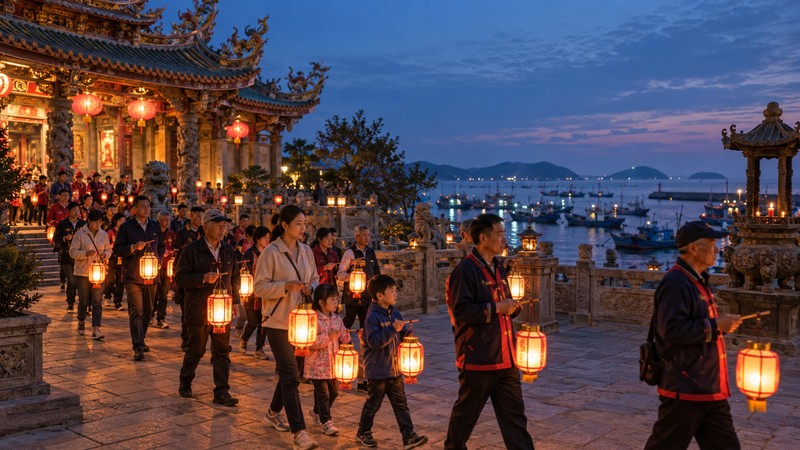
Mazu is commonly called a Chinese sea goddess, but that label is incomplete without living practice. UNESCO's Mazu belief and customs describes an influential coastal tradition involving oral accounts, temples, religious ceremonies, processions, and community identity. The element was inscribed on the Representative List of the Intangible Cultural Heritage of Humanity in 2009.
According to the tradition summarized by UNESCO, Mazu is believed to have lived in the tenth century on Meizhou Island and to have helped local people. The tradition later spread through coastal China and overseas communities. This is evidence about belief and commemoration; it should not be rewritten as a single historically verified biography.
The site's Mazu sea-goddess guide gives more background on origins, symbols, and worship. When writing about Mazu, distinguish community belief, historical documentation, later miracle stories, temple practice, and modern festival presentation.
Guanyin: why “goddess of mercy” needs context
Guanyin is widely known in English as the goddess of mercy. The more precise Buddhist identification is the bodhisattva of compassion, Avalokiteshvara. The National Museum of Asian Art's Guanyin glossary describes Guanyin as the widely worshipped bodhisattva who protects and saves beings.
Gender presentation also requires care. A National Museum of Asian Art object record for Guanyin with vase and willow twig explains that Guanyin has been described as a woman while earlier forms combined male and female elements. Chinese visual culture increasingly made female-presenting forms familiar, but that history is different from a simple tale of a goddess born into a fixed pantheon.
The vase, willow branch, lotus, and compassionate role are useful clues. The museum label, date, posture, attendant figures, and Buddhist context provide stronger evidence than the clues alone.
Compare source types before drawing conclusions
| Evidence type | What it can support | What it cannot prove by itself |
|---|---|---|
| Classical text passage | wording, sequence, and concepts in that textual witness | that every later community told the story the same way |
| Museum object record | object date, material, title, iconography, and curatorial interpretation | a complete history of the figure across all periods |
| Ritual or heritage documentation | living practice, community participation, transmission, and stated belief | a single factual biography of the sacred figure |
| Novel, play, or modern adaptation | the choices made in that work | that all details come from early mythology |
| Popular illustration | current visual recognition and creative interpretation | historical accuracy without a source trail |
For any claim, record the figure, source type, date or period, place, exact visible or textual evidence, and the conclusion you are drawing. If two sources differ, preserve the difference instead of smoothing it into one “complete” story.
This method also prevents visual mistakes. A moon, lotus, peach, or vase can guide a search, but identification should come from the full object record, inscription, or narrative context.
Frequently asked questions
Who is the main goddess in Chinese mythology?
There is no single main goddess across all Chinese mythic, religious, literary, and local traditions. Nuwa, Xiwangmu, Chang'e, Mazu, and Guanyin have different roles and source histories, so the answer depends on the story, community, period, and tradition being discussed.
Is Guanyin a Chinese mythology goddess?
Guanyin is more precisely the Buddhist bodhisattva of compassion, known in Sanskrit as Avalokiteshvara. “Goddess of mercy” is a familiar English label for female-presenting Chinese forms, but it should not erase the Buddhist identity or the history of changing gender representation.
Are Chang'e and Xiwangmu the same goddess?
No. Chang'e is associated with the moon and variant stories about an elixir. Xiwangmu is the Queen Mother of the West, a much older and changing figure linked with the western realm, immortality, and later peach-banquet imagery.
Is Mazu only a mythological character?
No. Mazu is at the center of living belief and custom in coastal communities, with temples, ceremonies, oral traditions, and processions. Story traditions are part of that history, but treating her only as a fictional sea-goddess character omits the religious and community context.
Why do Chinese goddess stories have different versions?
They developed across different texts, regions, religious traditions, visual arts, oral practice, theater, festivals, and modern adaptations. A changed motive or symbol may belong to a different source layer rather than being a simple error.
Enjoyed this story? Share it!
🐦 Share on Twitter📚 Related Books
Explore more Chinese mythology stories in our curated collection