Quick answer
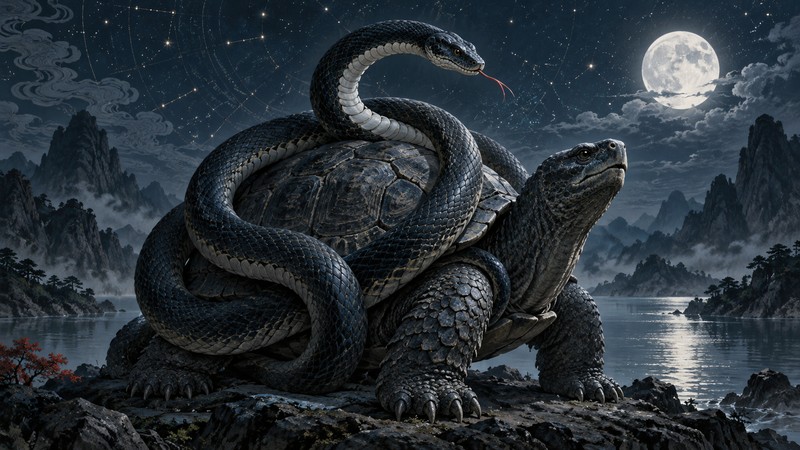
Xuanwu (玄武), often called the Black Tortoise, Dark Warrior, or Black Tortoise-Snake in English, is the guardian emblem of the north in the Chinese Four Symbols. Its traditional image is not simply a black turtle: it is usually a tortoise entwined with a snake. The emblem is associated with the north, winter, the color black, and the water phase. In later religious history, Xuanwu also became closely connected with the human-shaped Daoist deity Zhenwu, but the early directional emblem and the later god should not be treated as identical in every context.
Xuanwu at a glance
| Chinese name | 玄武 (Xuánwǔ) |
|---|---|
| Common English names | Dark Warrior, Black Tortoise, Black Tortoise-Snake |
| Visual form | A tortoise entwined with a snake |
| Direction and season | North and winter |
| Correlative element | Water |
| Larger system | One of the Four Symbols or Four Directional Animals |
Why Xuanwu is more than a black turtle
The shortest English label, “Black Tortoise,” can hide the feature that makes the image distinctive. The British Museum’s Xuanwu collection record describes the being as a Chinese mythological creature usually shown as a turtle-and-snake. It also identifies Xuanwu as the guardian of the north and links it with winter, black, and water.
The word xuan can suggest a dark or mysterious color, while wu carries a martial sense. That is why “Dark Warrior” is often a more literal translation than “Black Tortoise.” Still, the animal label remains useful because historical images commonly make the tortoise and snake the visible core of the emblem.
The safest way to recognize Xuanwu is to look for the tortoise-and-snake pair, not a solitary black turtle. A turtle by itself may symbolize longevity or serve another artistic purpose; the entwined pair points much more clearly to the northern emblem.
Xuanwu’s place among the Four Symbols
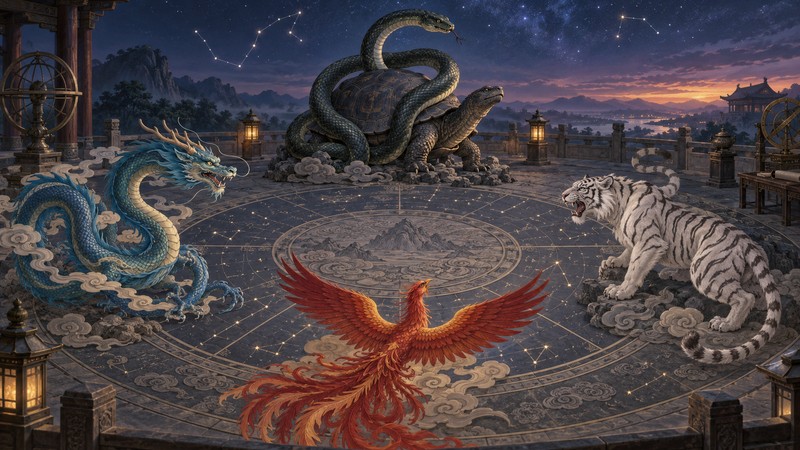
Xuanwu belongs to a directional system rather than to the twelve-animal Chinese zodiac. The other three emblems are the Azure or Blue-Green Dragon of the east, the Vermilion Bird of the south, and the White Tiger of the west. Together they organize directions, seasons, colors, and regions of the traditional sky.
This relationship is easier to understand by comparing Xuanwu with the site’s guide to the Four Symbols in Chinese mythology and its broader introduction to Chinese mythology symbols and meanings. Xuanwu is the northern member of that set; it is not a replacement name for every sacred turtle in Chinese stories.
What the tortoise and snake can signify
The tortoise can evoke endurance, strength, longevity, and a stable cosmic order. The snake can suggest water, movement, danger, or transformation, depending on the period and context. Those associations help explain why later writers found the combined image so rich, but they should not be turned into one universal secret meaning.
For a careful reading, begin with what an object actually shows and where it places the image. A tomb decoration, astronomical diagram, temple sculpture, and modern fantasy illustration may all use the tortoise-snake pair differently. The visual form is relatively stable; the explanation around it can change.
Xuanwu and Zhenwu: related, but not always interchangeable
One of the most important distinctions is historical. Xuanwu first functioned as a northern directional and celestial emblem represented by the tortoise and snake. A University of Kansas study, Representing the Daoist God Zhenwu, the Perfected Warrior, explains that Xuanwu was represented by a tortoise entwined with a snake and developed into an anthropomorphic god near the beginning of the Northern Song.
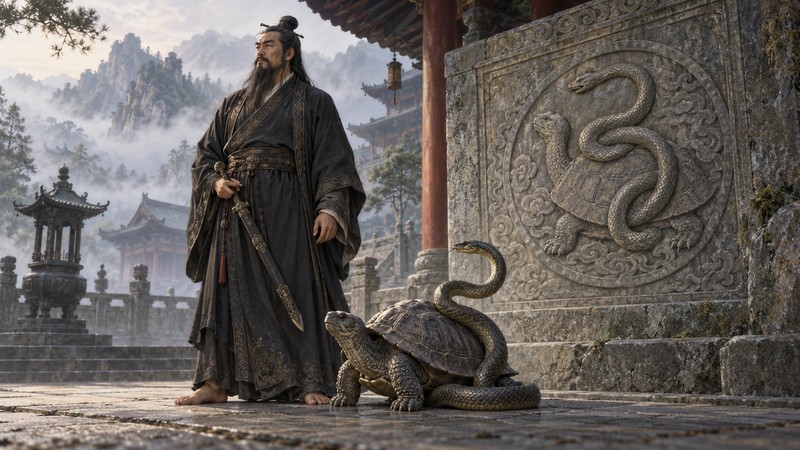
Later images of Zhenwu may show a human warrior-deity, often with the tortoise and snake at his feet. The older emblem remains visible inside the later religious iconography, but readers should still ask whether a source is discussing a celestial symbol, a mythological creature, or a worshipped Daoist deity.
Recent scholarship on Zhenwu imagery likewise treats the turtle-snake pair as a persistent visual marker inherited from Xuanwu. The open-access study on the Zhenwu sculpture at Dazu also connects the northern emblem with water and the color black while examining later religious interpretation.
How to identify Xuanwu in art
- Look for two animals. A snake wrapped around, crossing, or facing a tortoise is the strongest clue.
- Check the directional group. If a dragon, tiger, and red bird appear nearby, the image probably belongs to the Four Symbols.
- Notice the setting. Northern, winter, water, or dark-color associations can support the identification, but they are weaker evidence than the paired animals.
- Distinguish emblem from deity. A human warrior with a sword and the tortoise-snake pair usually points toward later Zhenwu iconography.
- Read the object’s own record. Museum catalogues and site labels can identify the period and religious context more reliably than a modern caption circulating without provenance.
Readers exploring related beings can continue with the site’s Chinese mythical creatures guide. That list provides context, while this page keeps the focus on Xuanwu’s specific visual and historical identity.
Is there one definitive Black Tortoise story?
No single plot defines every appearance of Xuanwu. The oldest layer is a directional and celestial emblem, while later religious traditions developed narratives and a human-shaped deity around it. Retellings may emphasize protection, demon-subduing, cosmic order, or cultivation. A responsible summary should name the version or context instead of merging those layers into one supposedly original story.
Frequently asked questions
Is Xuanwu a turtle or a tortoise?
English sources use both words. The more important identifying feature is that Xuanwu is traditionally represented as a tortoise or turtle entwined with a snake.
Is the Black Tortoise one of the Chinese zodiac animals?
No. Xuanwu belongs to the Four Symbols and the northern sky. The twelve-animal zodiac is a different system.
Are Xuanwu and Zhenwu the same?
They are historically connected, but context matters. Xuanwu can mean the older tortoise-snake emblem of the north, while Zhenwu usually refers to the later human-shaped Daoist deity who inherited that imagery.
Enjoyed this story? Share it!
🐦 Share on Twitter📚 Related Books
Explore more Chinese mythology stories in our curated collection