Quick answer: In the best-known early version of the Kuafu story, Kuafu races the sun, becomes desperately thirsty, drinks from the Yellow River and Wei River, and dies before reaching the Great Marsh. His discarded staff becomes a forest. The story can support readings about ambition, human limits, sacrifice, and what remains after failure, but those meanings are interpretations rather than an explicit moral in the Classic of Mountains and Seas.
What happens in the Kuafu chasing the sun story?
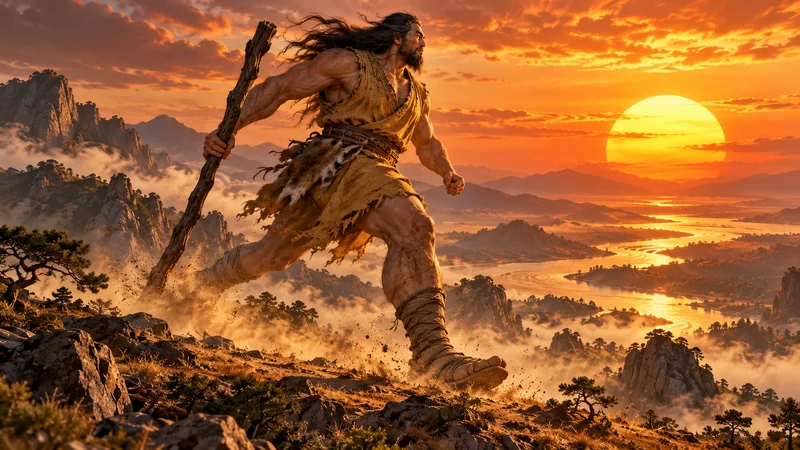
The compact account in the “Regions Beyond the Seas: North” section of the Classic of Mountains and Seas begins in motion: Kuafu races the sun and reaches the place where it sets. The text does not pause to explain why he begins the chase. That missing motive matters, because later retellings often supply a reason that the early passage itself does not give.
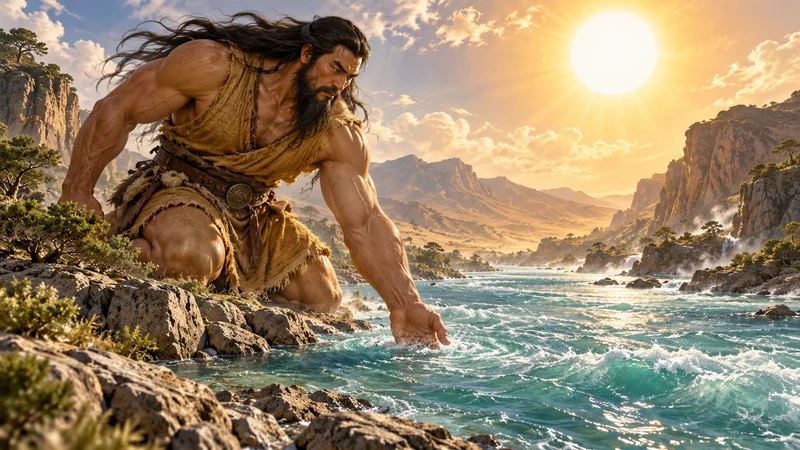
The pursuit creates the story’s crisis. Overcome by thirst, Kuafu drinks from the Yellow River and the Wei River, but their water is not enough. He turns north toward the Great Marsh, a vast body of water, and dies of thirst before reaching it. The ending then changes the scale of the story: Kuafu throws down or leaves his staff, and it becomes the Deng Forest.
The sequence is therefore clear even though the passage is brief:
- Cause: Kuafu chooses to race or pursue the sun; the early text does not state his motive.
- Process: he reaches the sun’s setting place, becomes thirsty, and drains two rivers.
- Result: he dies before reaching the Great Marsh, while his staff becomes a forest.
How do the early versions differ?
Two early texts preserve related versions, but they frame Kuafu differently. Keeping those differences visible is more accurate than blending them into one seamless modern plot.
| Source | What it says | Why the difference matters |
|---|---|---|
| Classic of Mountains and Seas, “Regions Beyond the Seas: North” | Kuafu races the sun, drinks the Yellow and Wei rivers, seeks the Great Marsh, dies, and leaves a staff that becomes Deng Forest. | The passage gives events without an explicit judgment of Kuafu’s goal. |
| Liezi, “The Questions of Tang” | Kuafu is introduced as failing to measure his strength and wanting to chase the sun’s shadow. After his death, the staff and the ground nourished by his body are linked with a Deng Forest extending for thousands of li. | This version adds an overt warning about overestimating one’s strength and expands the transformation at the end. |
The familiar Chinese idiom Kuafu zhuri (夸父逐日, “Kuafu chases the sun”) is often used for a bold or seemingly impossible undertaking. That later usage can praise determination or criticize unrealistic ambition, depending on context. It should not be treated as a single moral printed inside every ancient version.
What does Kuafu symbolize?
Because the Classic of Mountains and Seas tells the action without spelling out a lesson, several readings remain possible. The strongest interpretations stay tied to visible parts of the story:
- Ambition: the sun is an extreme target, so the chase can represent a refusal to accept ordinary limits.
- Limit and cost: Kuafu can cross great distances and empty rivers, yet his body still needs water. Extraordinary power does not erase physical limits.
- Transformation after loss: the staff becoming a forest turns a solitary death into a life-giving landscape. The result complicates a simple “failure” reading.
- Scale: the sun, rivers, marsh, and forest place one figure inside a vast mythic geography. The story is as much about the world around Kuafu as it is about his pursuit.
Why do modern retellings give Kuafu different motives?
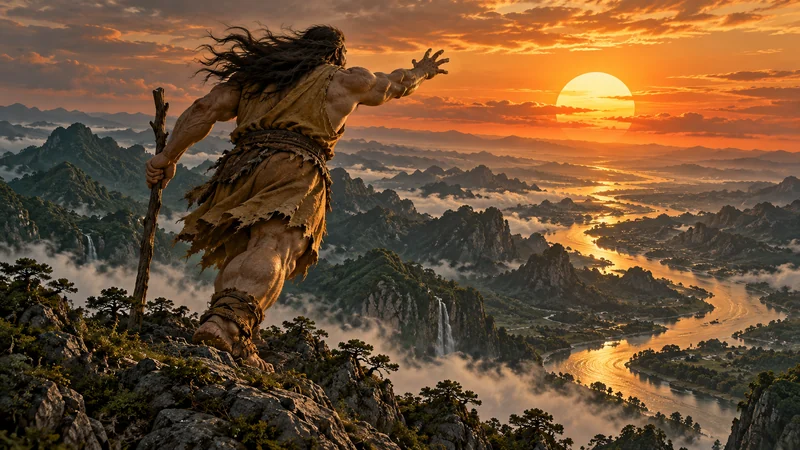
A modern storyteller usually wants a motive before the chase begins. Some versions make Kuafu a hero seeking light or warmth for his people; others present him as proud, curious, or determined to master nature. Those motives make a short ancient episode easier to dramatize, but they are additions unless a retelling identifies a source that contains them.
The same distinction applies to the ending. A retelling may emphasize Kuafu’s tragic defeat, his perseverance, or the forest as a legacy for later travelers. All three can be meaningful, but readers should be told when the page is interpreting the image and when it is summarizing a source.
A source-aware way to read the myth
Start with the shared narrative core: chase, thirst, rivers, death, and transformation. Then ask which source supplies any added motive or moral. This approach leaves room for imaginative retellings while keeping their relationship to the early texts clear.
For more context, explore the site’s Chinese mythology resources, its guide to Chinese gods and legendary figures, and other Chinese creation myths.
Sources used
- Classic of Mountains and Seas, “Regions Beyond the Seas: North”
- Liezi, “The Questions of Tang”
- Chinese Text Project parallel text of the Kuafu passage
Frequently asked questions
Why did Kuafu chase the sun?
The early Classic of Mountains and Seas passage does not give a motive. Explanations such as bringing light to people or proving his strength belong to later interpretations or retellings unless a source is named.
How did Kuafu die?
He died of thirst while traveling toward the Great Marsh after drinking from the Yellow River and Wei River.
What happened to Kuafu’s staff?
In the Classic of Mountains and Seas, his discarded staff became Deng Forest. The Liezi version expands the transformation by linking the forest with both the staff and the ground nourished by his body.
Is Kuafu’s story a warning against ambition?
The Liezi explicitly criticizes Kuafu for not measuring his strength, so a warning reading fits that version. The Classic of Mountains and Seas does not state the same moral, which also allows readings centered on determination, cost, and legacy.
Enjoyed this story? Share it!
🐦 Share on Twitter📚 Related Books
Explore more Chinese mythology stories in our curated collection