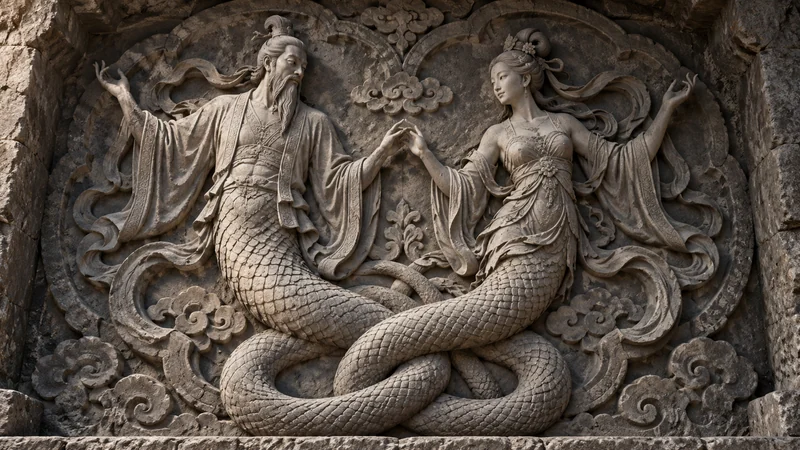
Fuxi and Nuwa are two foundational figures in Chinese mythology, but their traditions tell several different stories. Fuxi is especially associated with teaching people how to understand patterns in nature and how to obtain food. Nuwa restores a world damaged by disaster and, in another account, forms human beings from earth. In funerary images they often appear together, with human upper bodies and intertwined serpent tails.
Their shared image does not turn every story about either figure into one continuous biography. The early account of Fuxi’s inventions, the account of Nuwa repairing heaven, the clay-human tradition and the stories of a sibling couple belong to distinguishable sources. Their differences make the pair more interesting: they explain the beginnings of human life, the arts of civilization and the maintenance of an ordered cosmos.
Fuxi and Nuwa at a glance
| Subject | Fuxi | Nuwa |
|---|---|---|
| Principal role in the texts discussed here | Culture hero who observes nature and develops the eight trigrams and nets | Goddess who repairs heaven; maker of people in the yellow-earth tradition |
| Named textual evidence | Yijing, Xici, quoted in Taiping yulan, volume 78 | Huainanzi, Lanming xun; a Fengsu tongyi passage preserved in Taiping yulan |
| Appearance in paired art | Human upper body with a serpent lower body | Human upper body with a serpent lower body |
| Shared setting in the museum examples | Funerary paintings from Astana near Turpan, with celestial symbols and measuring instruments | |
| Relationship | Paired mythical ancestors; siblings and spouses in some foundation stories, without that relationship being stated in every account of their individual deeds | |
Fuxi: observing the world and teaching useful arts
The Xici, a commentary associated with the Yijing or Book of Changes, describes the ancient ruler Baoxi, another name for Fuxi, looking upward at the patterns of heaven and downward at the forms of earth. He studies the markings of birds and beasts, the conditions of the land, things close at hand and things farther away. From these observations he makes the eight trigrams, or bagua, to express the workings of the divine and distinguish the characteristics of things.
Each trigram consists of three lines, broken or unbroken. This story presents the signs as a way to understand an already existing world. Fuxi’s achievement is the recognition and communication of its patterns, rather than the physical separation of heaven and earth.
The same passage credits him with knotting cords into nets for hunting and fishing. The two achievements connect interpretation with livelihood: people learn to read the world and to work within it. Later traditions add other inventions and institutions, but the trigrams and nets are concrete deeds in this particular passage. The text is preserved among the Fuxi quotations in Taiping yulan, volume 78, a later encyclopedia that identifies the works it quotes.
Nuwa repairs heaven after catastrophe
In Huainanzi, Lanming xun, the world is already populated when calamity strikes. The four supporting extremities fail and the nine regions split apart. Heaven cannot cover everything and earth cannot bear everything. Fires rage without going out, waters spread without subsiding, and dangerous beasts and birds prey upon people.
Nuwa responds with a series of acts. She melts five-colored stones to mend the sky. She cuts off the legs of the great turtle Ao to establish the four supports, kills a black dragon to aid the region of Ji, and piles up reed ashes to stop the floodwaters. The repaired sky and restored supports allow people to live safely again.
This is a story of restoration, with Nuwa acting as the protector of a threatened world. The passage does not describe her making humans at the same moment, and it does not give Fuxi a part in her repair. Nor does it explicitly identify the initial catastrophe here as a blow struck by Gonggong. Gonggong striking Mount Buzhou appears in Huainanzi’s separate Tianwen xun; familiar retellings can join the two episodes into a longer plot.
Nuwa makes people from yellow earth
A different origin story, attributed to Fengsu tongyi and preserved in Taiping yulan, begins when heaven and earth have opened but there are no people. Nuwa shapes yellow earth into human beings. The work becomes too demanding for her to keep up, so she draws a cord through mud and lifts it to make more people.
The recorded story goes on to explain social rank: those made from individually shaped yellow earth become the rich and eminent, while those produced by the cord become ordinary people. That hierarchy belongs to the source’s explanation of its society; it is not a claim about the actual worth or origin of human beings. The important narrative distinction is that this passage names Nuwa as the maker, rather than describing Fuxi and Nuwa jointly sculpting everyone.
Making people and repairing heaven give Nuwa complementary roles, as a source of life and as its defender. They remain separate episodes in the evidence discussed here. A modern retelling may place them one after another, but that sequence is the reteller’s arrangement.
Why Fuxi and Nuwa appear together with serpent tails
Art provides another way to encounter the pair. The British Museum’s funerary banner, number 1928,1022,0.203, comes from the Astana cemetery and is dated approximately to the sixth or seventh century. It shows Fuxi and Nuwa with intertwined serpent bodies, a sun above, a moon below and surrounding stars. In this object Fuxi holds a graduated set-square and Nuwa holds what the museum identifies as apparently a compass.
The National Museum of Korea’s painting, accession Bongwan4027, is also from Astana. Its interpretation connects the measuring instruments with round heaven and square earth, while the celestial bodies make the picture a miniature cosmos. These are funerary objects with specific archaeological settings. Their entwined ancestors and ordered heavens address origins and cosmic continuity, rather than illustrating every event in one written creation story.
The distribution of the instruments is not identical in all examples. The British Museum notes variations among Astana banners, so a compass or square should be described with reference to the particular object. The two illustrations retained on this page are modern AI-created interpretations, as their captions state; neither is the excavated banner or painting described above.

The sibling couple and the flood-survivor tradition
Some foundation stories make Fuxi and Nuwa both brother and sister and husband and wife. The National Museum of Korea’s explanation of its Astana painting recounts a version in which they are the only survivors of a great flood. They must repopulate the world, and make clay figures that come to life with divine assistance. In this telling the pair share the task of giving humanity a new beginning.
That account differs from the yellow-earth passage naming Nuwa alone. It also differs from the Xici passage about Fuxi’s inventions, which does not tell a marriage story. Calling them siblings and spouses is therefore accurate for particular paired-ancestor traditions, while calling that relationship the premise of every early Fuxi or Nuwa passage would erase the differences.
The pair’s symbolism likewise depends on the episode. Nets and trigrams emphasize the development of human arts; Nuwa’s stones and turtle supports emphasize rescue and stability; the joined figures, measuring instruments and stars emphasize ancestry and cosmic order. These readings arise from the specific acts and objects, rather than from a single compulsory moral attached to all versions.
Frequently asked questions
Who are Fuxi and Nuwa?
Fuxi is a culture hero associated with the eight trigrams and fishing and hunting nets. Nuwa is a goddess associated with repairing the sky and, in another tradition, making people from earth. They also appear together as mythical ancestors in funerary art.
Are Fuxi and Nuwa brother and sister or husband and wife?
Some ancestor stories identify them as siblings who become spouses, and the National Museum of Korea describes a flood-survivor foundation myth. Their relationship is not specified in every early passage about their separate deeds.
Did Fuxi and Nuwa create humans together?
Some paired-ancestor retellings give both a role in humanity’s beginnings. The yellow-earth account attributed to Fengsu tongyi and preserved in Taiping yulan specifically names Nuwa as the maker.
What do their snake bodies, compass and square mean?
The intertwined serpent bodies identify the paired ancestors in many images. Their measuring instruments and surrounding sun, moon and stars express cosmic order in museum interpretations; the arrangement of the instruments varies between objects.
Did Fuxi help Nuwa repair the sky?
The sky-repair passage in Huainanzi, Lanming xun, credits Nuwa with the repair. It does not narrate Fuxi joining her in that episode.
Sources and related stories
The textual sources above are available as Chinese transcriptions. Taiping yulan preserves quotations from earlier works, so its date should not be mistaken for the date of every quoted tradition. Museum records document particular surviving objects and supply curatorial interpretations. For other episodes, see Chinese creation stories and Pangu; Pangu’s separation of heaven and earth is a distinct creation narrative.
Enjoyed this story? Share it!
🐦 Share on Twitter📚 Related Books
Explore more Chinese mythology stories in our curated collection