Quick answer: The Chinese mythology Eight Immortals story concerns Li Tieguai, Zhongli Quan, Zhang Guolao, Lü Dongbin, He Xiangu, Lan Caihe, Han Xiangzi, and Cao Guojiu. They became a widely recognized group through folklore, art, drama, and fiction. In chapter 48 of Wu Yuantai’s Dongyouji, each immortal places an object on the sea and crosses by displaying an individual power, creating the story behind the saying “the Eight Immortals cross the sea, each showing their own ability.”
Who are the Eight Immortals?
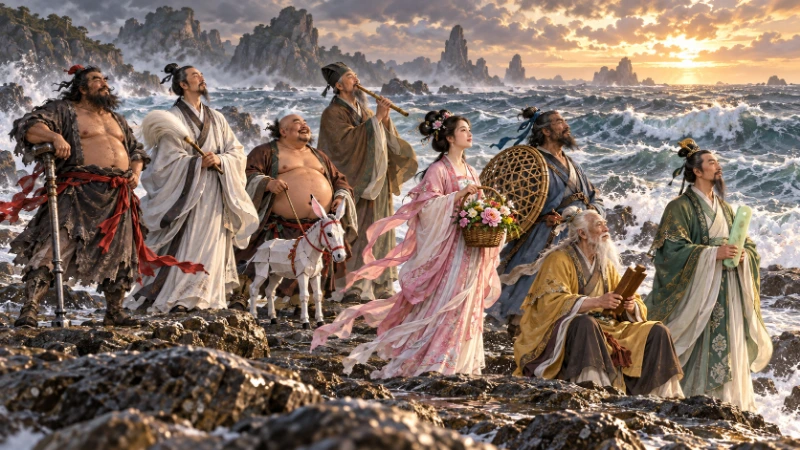
The standard group now recognized as the Eight Immortals contains seven male figures and one female figure. Their legends did not begin as one fixed biography. Stories about different groups of “eight immortals” circulated over many centuries, and the familiar set gradually became established through repeated adaptation.
| Immortal | Common identifying emblem | Basic story boundary |
|---|---|---|
| Li Tieguai (Iron-Crutch Li) | Iron crutch and gourd | A legendary figure associated with healing and relief from suffering. |
| Zhongli Quan (also called Han Zhongli) | Fan | A major Daoist immortal; later traditions connect him with the Quanzhen patriarchs. |
| Zhang Guolao | Fish drum; often a donkey in stories | Legends developed around a Tang-period Daoist named Zhang Guo. |
| Lü Dongbin | Sword | The best-known member of the group, with a large independent body of tales. |
| He Xiangu | Lotus | The only woman in the standard group; regional traditions give different places of origin. |
| Lan Caihe | Flower basket | A wandering figure whose identity and presentation vary across stories and art. |
| Han Xiangzi | Bamboo flute | Folklore connects him with Han Xiang, a relative of the Tang writer Han Yu, although the historical identities may have merged. |
| Cao Guojiu | Jade tablet | Tradition identifies him as an imperial maternal uncle associated with the Northern Song court. |
These emblems are common visual identifiers, especially in later art. They are not a master list that every story must follow. A novel may assign different objects to serve a particular scene.
What happens when the Eight Immortals cross the sea?
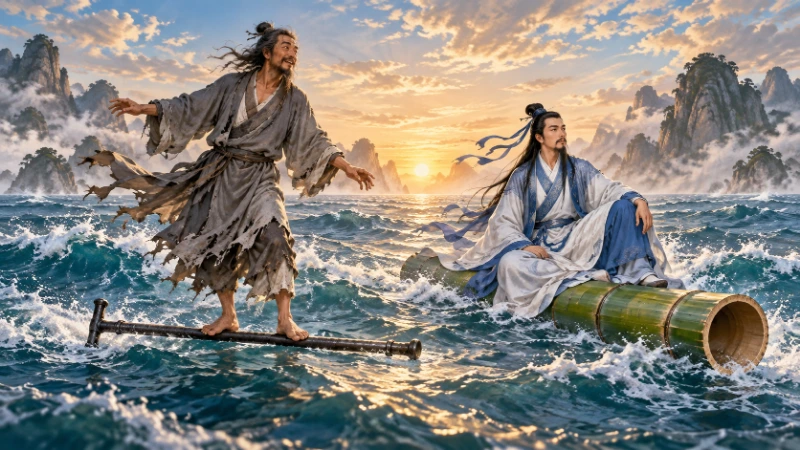
Chapter 48 of Dongyouji is titled “The Eight Immortals Journey East and Cross the Sea.” At the East Sea, Lü Dongbin proposes that they avoid crossing on clouds. Instead, each should throw one object onto the water and reveal an individual skill.
The chapter’s departure list is specific: Li Tieguai rides his iron crutch; Zhongli crosses on a whisk; Zhang Guolao uses a paper donkey; Lü Dongbin uses a xiao pipe; Han Xiangzi uses a flower basket; He Xiangu uses a bamboo cover; Lan Caihe uses clappers; and Cao Guojiu uses a jade tablet.
The crossing causes conflict. A dragon prince sees a bright treasure on the water, seizes Lan Caihe, and imprisons the immortal. Lü Dongbin demands Lan’s release and threatens to burn the sea. After the confrontation, the Dragon King orders Lan Caihe freed.
There is a visible inconsistency inside the chapter: the departure list gives the jade tablet to Cao Guojiu and clappers to Lan Caihe, but the following episode describes Lan standing on a jade tablet. A source-aware retelling should preserve that mismatch instead of silently moving the objects to make the passage look uniform.
Why do their objects change between art and the story?
Common iconography helps viewers recognize the group: Li Tieguai’s gourd, Zhongli Quan’s fan, Zhang Guolao’s fish drum, Lü Dongbin’s sword, He Xiangu’s lotus, Lan Caihe’s flower basket, Han Xiangzi’s flute, and Cao Guojiu’s jade tablet. Chapter 48 chooses a different set for several characters because the objects act as vehicles in a sea-crossing episode.
This is a useful example of how Chinese mythology changes across media. A temple painting needs stable emblems that identify figures at a glance. A narrative scene needs props that create action and conflict. Neither list erases the other.
The meaning of the sea-crossing story
The well-known saying based on the episode describes people meeting the same challenge through their own abilities. That reading fits the structure of the chapter: the immortals share a destination, but each chooses a different means of crossing.
The story also warns that a display of power can create consequences. The crossing becomes more than a parade of magical objects once the dragon prince intervenes and the group must recover Lan Caihe. Individual skill begins the episode; collective responsibility brings the captured companion back.
Sources, variants, and retellings
The names, biographies, attributes, and adventures of the Eight Immortals developed through many layers of folklore and literature. It is safer to identify a specific source for a specific plot than to call one novel’s details the universal canon. Dongyouji chapter 48 supports the sea-crossing sequence described here. Museum and cultural-history sources support the standard group and common iconographic attributes.
Continue with the site’s overview of Chinese mythology, its guide to Chinese gods and immortals, and its introduction to Chinese creation stories.
Sources used
- Dongyouji, chapter 48
- Academy of Chinese Studies: Eight Immortals
- The Metropolitan Museum of Art: The Eight Immortals
Frequently asked questions
What are the names of the Eight Immortals?
They are Li Tieguai, Zhongli Quan, Zhang Guolao, Lü Dongbin, He Xiangu, Lan Caihe, Han Xiangzi, and Cao Guojiu.
Which book tells the Eight Immortals crossing the sea story?
A detailed literary version appears in chapter 48 of Wu Yuantai’s Dongyouji, where each immortal places an object on the water to cross the East Sea.
Did each immortal always carry the same object?
No. Later art uses common identifying emblems, but individual stories can assign different objects. The departure list in Dongyouji chapter 48 does not exactly match the standard iconographic set.
What does “the Eight Immortals cross the sea” mean?
The saying means that people facing the same challenge can each use their own abilities or methods. It comes from the scene in which the immortals cross by displaying different powers.
Enjoyed this story? Share it!
🐦 Share on Twitter📚 Related Books
Explore more Chinese mythology stories in our curated collection