Quick Answer: In English translations and adaptations of Journey to the West, “demon king” is a flexible title used for powerful supernatural rulers and antagonists. The Bull Demon King, or Niú Mówáng (牛魔王), is the best-known example, but the novel also presents other independent monster-kings and demon lords.
Searching for a “Chinese mythology demon king” can produce a confusing mix of the Bull Demon King, unnamed monster rulers, game characters, and modern fantasy villains. The safest way to read the phrase is to ask which story is being discussed, what Chinese title or creature name lies behind the translation, and whether the page describes an old text or a new adaptation.
In this article, “demon king” is read within Journey to the West and its English translation history: it is a recurring type of title, not the name of one character who controls every supernatural antagonist in the novel. That source boundary prevents a literary translation from being mistaken for a complete map of Chinese religion or folklore.
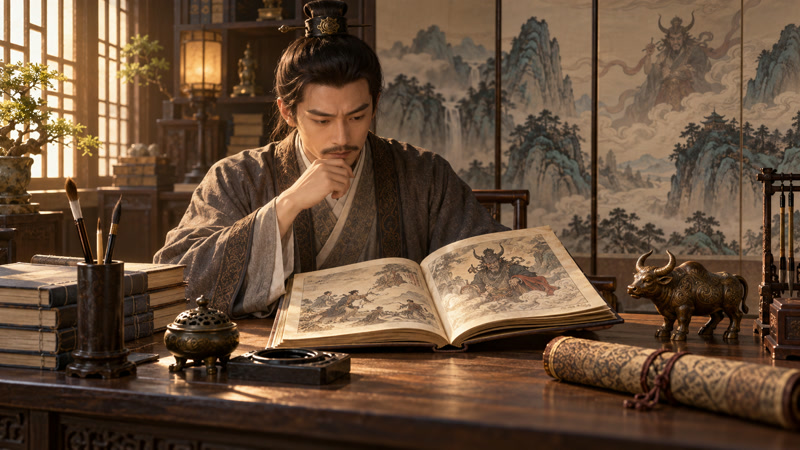
Basic Facts About the “Demon King” Label
| What it usually means | A powerful supernatural ruler, monster lord, or antagonist in a particular narrative. |
|---|---|
| Best-known example | The Bull Demon King from Journey to the West. |
| What it does not mean here | One character who controls every supernatural antagonist in Journey to the West. |
| Main source boundary | The famous Bull Demon King belongs to a sixteenth-century literary novel shaped by older religious and folkloric materials. |
| Translation caution | English editions may use words such as demon, fiend, monster, spirit, or monster-king for different figures and contexts. |
Quick reference: identify the work, the named character, the translator’s wording, and the adaptation date before treating “demon king” as a stable identity.
The Bull Demon King Is the Best-Known Example
Journey to the West is a sixteenth-century novel about Xuanzang and three supernatural disciples seeking Buddhist scriptures. The University of Chicago Press describes the work as a mixture of adventure, allegory, satire, and fantasy, and its table of contents places the Bull Demon King in the Flaming Mountain sequence in chapters 59–61.
The Bull Demon King is a major recurring character in Journey to the West. A 2022 academic study emphasizes that he and the characters around him influence several of the pilgrims’ hardships, giving him a more sustained role than many monsters who appear in a single encounter.
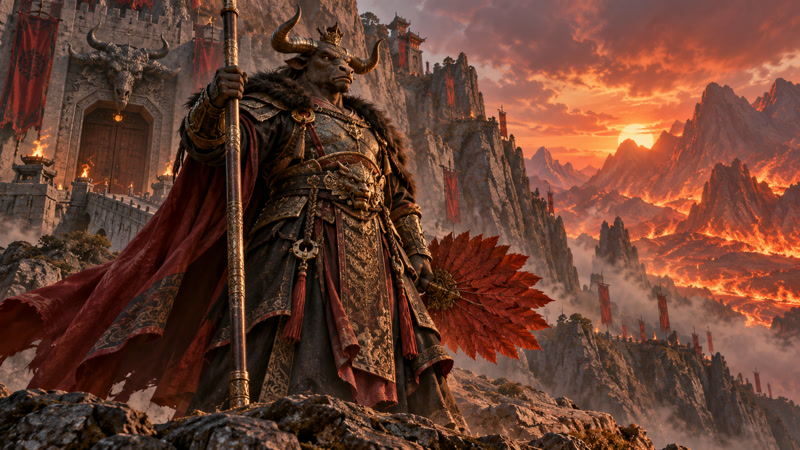
That narrative role explains why modern English-language pages often treat him as the Chinese demon king. The shortcut is understandable, but it turns one prominent character into a catch-all label. Within the novel, nearby episodes present separate antagonists with their own names, territories, and conflicts rather than describing one command structure led by the Bull Demon King.
Readers who want the wider narrative context can compare the site’s guide to the Monkey King story. For a broader creature boundary, see Chinese mythology monsters; for the difference between literary stories and a single origin account, use the Chinese mythology origin guide.
Why the English Title Does Not Name One Character
The chapter list in Anthony C. Yu’s translation uses several English labels across nearby episodes: demon, fiend, monster-king, monster, and demon lord. This variation is useful evidence that English wording follows the narrative context and translation choice rather than pointing to one standardized divine rank.
It also helps to separate three layers:
- Religious beings: gods, protectors, ghosts, and other beings may have ritual or devotional settings outside a novel.
- Folkloric creatures: local stories can describe animal spirits, ghosts, or dangerous beings without placing them under one king.
- Literary antagonists: a novel can give a monster a court, cave, army, family, or royal title because those details serve the plot.
Within a fantasy episode, “king” can signal power, territory, or self-presentation. Readers should not turn that narrative title into a permanent office without evidence from the work being discussed. Treating every opponent in Journey to the West as a servant of one demon emperor would add a hierarchy that the cited volume does not describe.
Other Demon Rulers Are Story-Specific
Journey to the West repeatedly introduces supernatural opponents with their own caves, followers, treasures, transformations, and local claims to authority. The University of Chicago Press summary describes Xuanzang’s encounters with many demons and spirits, while the volume’s chapter titles move among distinct demon lords and monster-kings. The pattern is plural and episodic.
| Reading question | Better interpretation |
|---|---|
| Is this the Bull Demon King? | Check for the Flaming Mountain, Princess Iron Fan, Red Boy, or his relationship with Sun Wukong. |
| Is “demon king” only a translation? | Compare the character’s Chinese name and the translator’s terminology before assuming a fixed category. |
| Does the figure belong to worship? | Look for evidence of ritual, temple, or devotional practice instead of inferring it from a novel title. |
| Is the hierarchy ancient? | Check whether it comes from the old narrative, a later opera or painting, or a modern game and animation. |
Art and Adaptation Can Change the Emphasis
Later art does not merely repeat a text. It selects a confrontation, redesigns a costume, or turns one episode into a symbol for a new audience. The Metropolitan Museum of Art, for example, dates Cheng Shifa’s album to 1978 and identifies one leaf as “The Monkey-King Beats the White-Boned Demon,” a scene from the epic Journey to the West. The record documents later visual reception of a named literary episode; by itself, an artwork record does not establish a universal religious status for its characters.
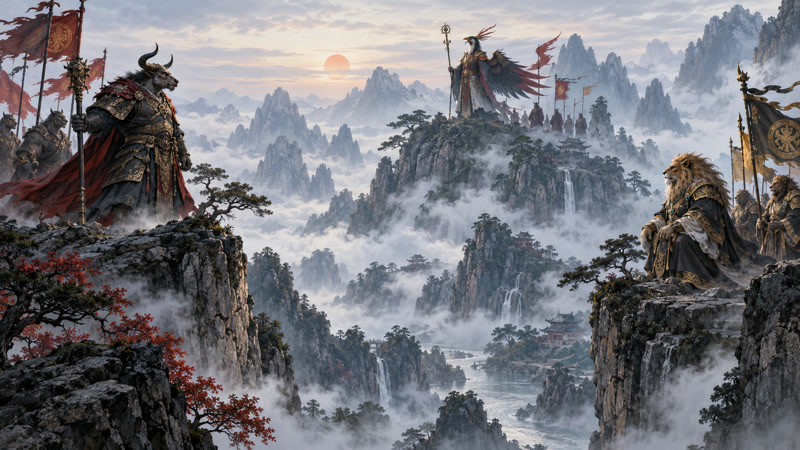
Modern games, television series, comics, and online summaries often streamline this complexity. They may merge figures, strengthen family relationships, invent military ranks, or use “Demon King” as a dramatic proper name. Those choices can be effective storytelling, but they should be labeled as adaptation rather than evidence for the original novel’s character hierarchy.
A Reliable Way to Read Any Demon King Character
- Name the source. Is the figure in a novel, temple story, local legend, opera, film, or game?
- Find the original name. A translated title alone may hide whether the source calls the figure a king, spirit, monster, ghost, or another kind of being.
- Locate the episode. Territory, family, weapon, and conflict usually identify the correct character more reliably than a generic title.
- Separate plot from belief. A supernatural character in literature is not automatically an object of religious practice.
- Label later additions. If a power, rank, or relationship appears only in a modern adaptation, say so.
This method preserves the excitement of the story while avoiding a false one-ruler system. It also makes comparisons more useful: readers can ask how each work builds authority, danger, loyalty, and transformation instead of forcing every antagonist into the same category.
Sources and Further Reading
- University of Chicago Press: The Journey to the West, Revised Edition, Volume 3
- KCI: Buddhist Cultural Interpretation of the Character of Bull Monster King in Journey to the West
- The Metropolitan Museum of Art: Cheng Shifa, Various Subjects
Frequently Asked Questions
Who is the demon king in Chinese mythology?
In searches centered on Journey to the West, the Bull Demon King is usually the intended figure. The novel also contains other separately named monster-kings and demon lords, so the English label should be tied to a character and episode.
Is the Bull Demon King a god?
In the cited evidence, he is a supernatural literary character in Journey to the West. Symbolic readings of the character should not erase that source boundary or turn his novel title into proof of religious status.
Are all demon kings in Chinese stories the same character?
No. Different stories and adaptations use kingly titles for different supernatural rulers. Names, territories, family ties, and episodes are needed to identify them.
Why do English translations use demon, monster, and fiend?
English translators make contextual choices for varied supernatural beings and narrative roles. Readers should compare the original character name and the specific edition rather than treating every English label as one fixed category.
Enjoyed this story? Share it!
🐦 Share on Twitter📚 Related Books
Explore more Chinese mythology stories in our curated collection