Quick answer
Chinese mythology can work well for children when the adult chooses a manageable episode, explains that old stories often have more than one version, and leaves time for questions. A useful first set includes Jingwei Filling the Sea, Hou Yi and the Ten Suns, Chang'e and the Moon Rabbit, a short Monkey King episode, and Nuwa Repairing the Sky.
These stories do not come from one single book or one fixed canon. Some appear in early compilations, some grew through later literature and performance, and some familiar details became prominent in art and folklore. For children, that source history can be a benefit: it shows how stories travel and change.
A practical way to begin
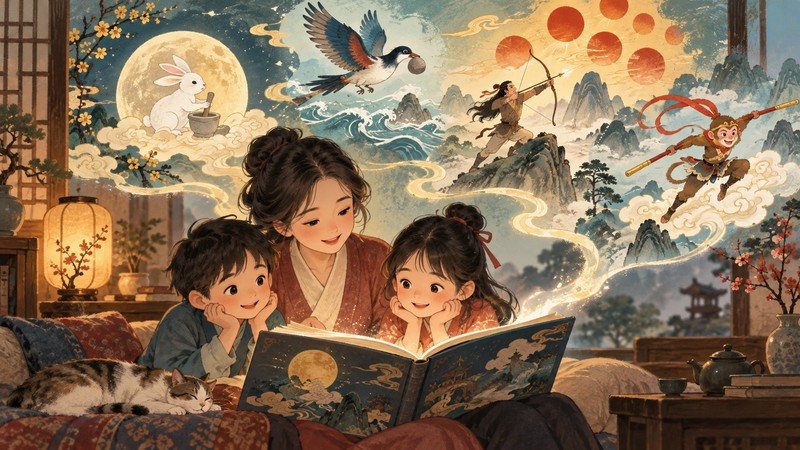
Start with one story rather than a list of gods and creatures. Read or tell it in ten minutes, name one early or influential source, and ask one open question. The goal is comprehension and curiosity, not memorizing a family tree of deities.
Before reading, preview three things:
- The emotional challenge: Does the story include death, family separation, punishment, frightening creatures, or intense conflict?
- The source layer: Is it from an early text, a later novel, festival folklore, visual art, or a modern retelling?
- The stopping point: Choose a complete episode with a clear beginning, challenge, and ending.
Age labels on books help, but they are only a starting point. A child's prior knowledge, sensitivity, language level, and the adult's way of telling the story matter just as much.
Five stories to start with
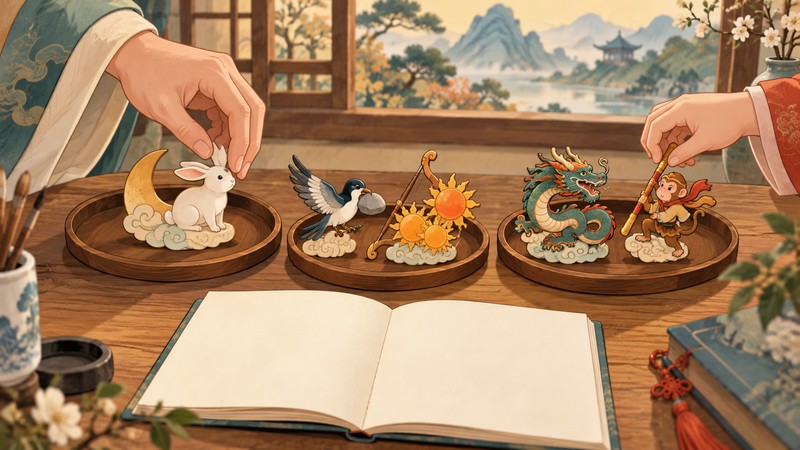
| Story | A child-friendly focus | A detail to handle carefully | Good first question |
|---|---|---|---|
| Jingwei Filling the Sea | persistence and an impossible task | Jingwei's transformation follows the girl's death | What can persistence change, and what can it not change? |
| Hou Yi and the Ten Suns | using skill to answer a public danger | versions differ on the number of suns shot and later events | When does a powerful action become necessary? |
| Chang'e and the Moon Rabbit | the moon, separation, memory, and festival imagery | Chang'e's reason for taking the elixir varies | How does each version change how we judge her choice? |
| Monkey King episode | wit, pride, teamwork, and consequences | the complete novel contains satire, violence, and religious layers | Is cleverness enough to make a good hero? |
| Nuwa Repairing the Sky | restoration after disorder | creation and sky-repair episodes come through different textual traditions | Why do repair stories matter after a disaster? |
1. Jingwei Filling the Sea
Jingwei is small, but her task is enormous: she carries twigs and stones to the sea. The story is memorable because action and scale are easy to picture. It can open a discussion about courage, grief, persistence, and the limits of individual effort.
The basic tradition is associated with the Classic of Mountains and Seas. The Chinese Text Project edition of the Shanhaijing lets readers see the larger textual collection instead of treating a modern picture-book version as the only source. Its online English translations may include machine- or user-generated material, so use them as a guide to the Chinese text rather than as an unquestionable final translation.
For younger children, state the loss simply and without graphic detail: a girl dies in the sea and returns as a bird determined to fill it. The site's fuller Jingwei Fills the Sea story provides more context and retelling boundaries.
2. Hou Yi and the Ten Suns
This is a clear problem-and-response story. Too many suns appear, the land suffers, and the archer Yi acts. Children can map cause, decision, action, and consequence without needing every later episode connected with Yi.
Early source traditions are not identical. The Huainanzi text collection preserves one important early textual layer, while later compilations quote or expand the episode. A responsible retelling should say “in one version” when it reaches details that vary, especially which details of the sun-shooting episode the source states explicitly and how Yi's later life connects with other figures.
Ask children to compare power with responsibility. The detailed Hou Yi Shoots the Suns story can support a second reading after the short version.
3. Chang'e and the Moon Rabbit
Chang'e stories are useful around the Mid-Autumn Festival because children can connect narrative, the visible moon, food, family gatherings, and works of art. They also teach an important source lesson: the reason Chang'e takes an elixir changes across retellings, so her action can look selfish, protective, accidental, or tragic depending on the version.
The moon rabbit is related but should not be flattened into a single unchanging companion story. The Metropolitan Museum of Art's Year of the Rabbit exhibition notes the rabbit's place in literature and folklore and its appearance with Chang'e and the elixir in Chinese art. That material helps children compare a written story with an image.
Use the site's comparison of Chang'e stories when you want to show how one changed motive creates a different moral judgment.
4. One Monkey King episode
Sun Wukong is attractive to young readers because he is funny, powerful, impatient, and often wrong. The safest entry is one self-contained episode rather than a compressed claim to cover all of Journey to the West.
The novel works on several levels. Columbia University's Journey to the West introduction treats it as a major literary work and supplies a teaching guide. Its elementary China resources also point teachers toward enacting selected Monkey episodes. Those resources are a reminder that the Monkey King is a literary character shaped by a long novel, theater, religion, and popular culture, not simply a free-floating “ancient god.”
After reading, ask whether cleverness without patience helps or harms the group. The site's Monkey King story guide identifies the novel and the historical pilgrimage background.
5. Nuwa Repairing the Sky
Nuwa's sky-repair story gives children a restoration narrative: the world is damaged, materials are gathered, and order is rebuilt. It works especially well with art activities because children can represent broken and repaired patterns without needing to depict violence.
Do not merge every Nuwa tradition into one seamless biography. Creation of humans, sky repair, flood traditions, and later iconography appear in different sources and retellings. Read the site's Nuwa Mends the Sky story as one guided account, then invite children to mark which details belong to the selected version.
Match the story to the reader
| Flexible reading stage | What usually helps | What to avoid |
|---|---|---|
| Early primary or first-time listener | one short episode, repeated images, a clear action, gentle explanation of loss | graphic detail, long genealogies, presenting symbols as fixed facts |
| Middle primary | competing choices, two versions of one event, a simple source note | forcing one moral answer or mixing novel and ancient text without labels |
| Older primary and early secondary | translation comparison, historical context, visual-art evidence, adaptation analysis | assuming every modern film or game detail comes from an ancient source |
These bands are flexible. A younger child who knows the story may handle more complexity, while an older child may still prefer a brief, less intense retelling.
Turn the reading into a conversation
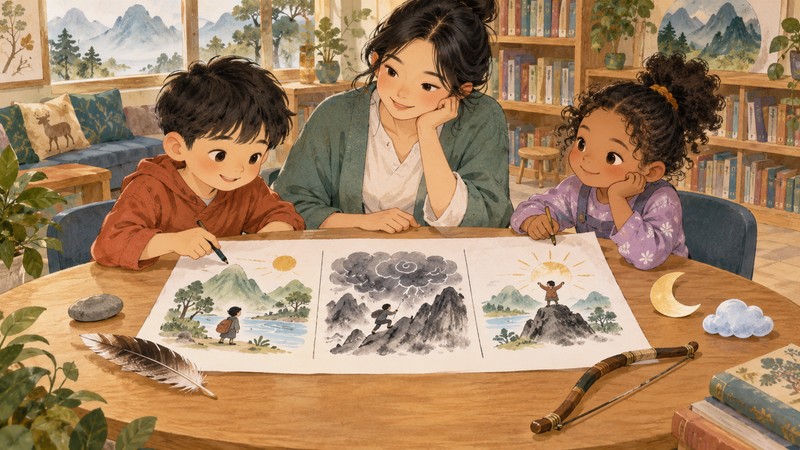
Use a three-part story map: beginning, challenge, and ending. Then add two boxes: the character's choice and our question. This keeps summary separate from interpretation.
Try these prompts:
- What problem does the character face?
- What choice changes the story?
- Which detail tells us what the character values?
- Did the ending solve the original problem?
- What changed when we read a second version?
If children disagree, return to the words or images in the version you used. A discussion becomes stronger when a child can point to evidence rather than guess what a story “must” mean.
Keep the source note simple
Children do not need a lecture on textual history, but they should hear honest labels. A one-sentence note is enough:
- “This story appears in an early collection called the Classic of Mountains and Seas.”
- “This episode belongs to a much later novel called Journey to the West.”
- “Artists also showed this figure in paintings, mirrors, textiles, and festival objects.”
- “Other books tell this part differently.”
That habit prevents a modern adaptation, a late folk detail, and an early written source from being presented as the same kind of evidence.
Frequently asked questions
What is the best first Chinese myth for a child?
Jingwei Filling the Sea is a strong short choice because its action is easy to follow and its central image is memorable. Adults should briefly explain the girl's death and then invite questions about persistence and scale.
Is the Monkey King a mythological god?
Sun Wukong is best introduced as the central Monkey character in the Ming novel Journey to the West, shaped by earlier stories, religion, theater, and later popular culture. Calling him only an ancient god hides that literary history.
Are Chinese myths too violent for children?
Some include death, punishment, monsters, war, or family separation. Adults can choose one episode, remove graphic detail without erasing the event, and preview the story for the individual child.
Why do different books tell the same myth differently?
The stories developed across texts, regions, oral performance, visual art, festivals, novels, and modern media. Different motives or endings may come from distinct source layers rather than one author making a simple mistake.
How can a teacher use Chinese mythology without oversimplifying it?
Name the source or source type, distinguish early texts from later novels and adaptations, compare two versions when useful, and ask children to support interpretations with a detail from the story or image.
Enjoyed this story? Share it!
🐦 Share on Twitter📚 Related Books
Explore more Chinese mythology stories in our curated collection