Chinese mythology has no single, universal account of the afterlife. Across different periods and communities, ideas about ancestors, tombs, heavenly paradises, bureaucratic judgment, karma, rebirth, and immortality overlap. A useful guide therefore asks which tradition and historical setting a story belongs to instead of forcing every belief into one map.
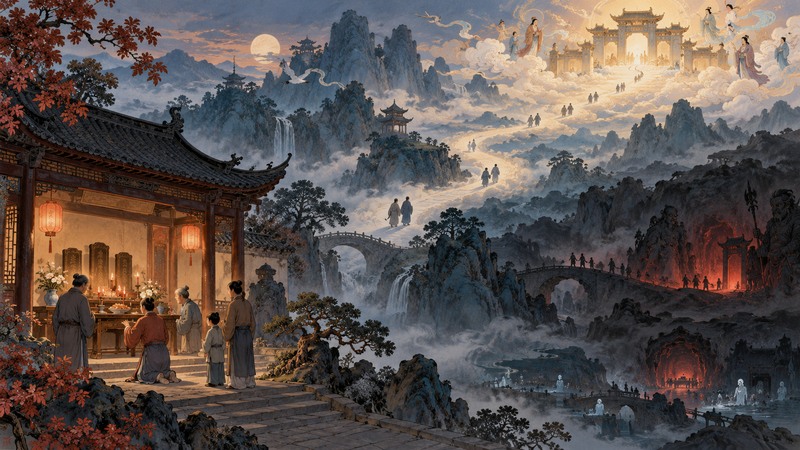
The four main layers readers encounter
Ancestors and family rites
The dead may remain part of the family’s moral and ritual world through remembrance and offerings.
Early tomb worlds
Burials could furnish a continued existence with models of people, animals, buildings, and daily goods.
Buddhist rebirth and judgment
Karma, rebirth, and postmortem courts shaped influential later images of the underworld.
Daoist and popular heavens
Immortals, celestial officials, paradises, local gods, and ritual specialists add other routes and authorities.
| Question | A common answer | Necessary caution |
|---|---|---|
| Where do the dead go? | A tomb realm, ancestral sphere, underworld court, paradise, or a new rebirth may appear. | These destinations come from different periods and traditions. |
| Who judges the dead? | Yanluo Wang or the Ten Kings often appear in Buddhist-popular accounts. | The Jade Emperor is not simply the judge in every story. |
| Is punishment permanent? | Many underworld stories connect judgment and punishment to a process before rebirth. | Texts, temple traditions, and modern retellings vary. |
| Can the living help? | Rituals, offerings, merit-making, and remembrance may sustain or assist the dead. | Practice differs by region, family, and religious community. |
Early tombs imagined continued existence
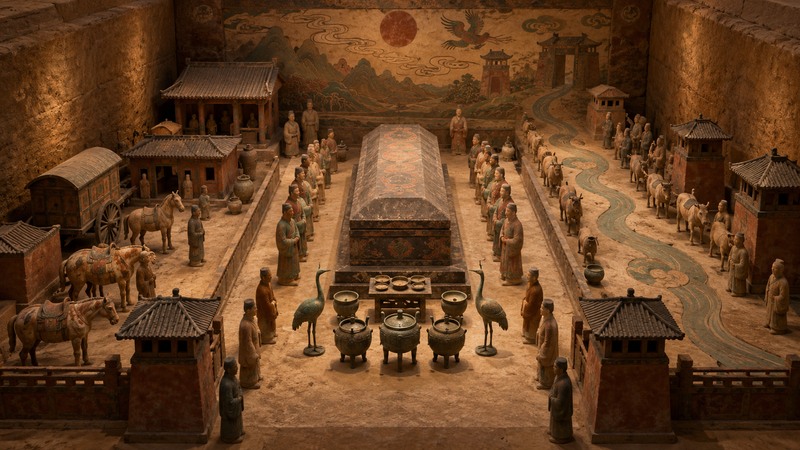
Long before later illustrated hell courts became familiar, Chinese burials already expressed relationships between the living and the dead. Tombs could be organized as protected spaces and supplied with objects for continued existence. The Metropolitan Museum of Art describes mingqi, or “spirit goods,” as figures and models that reveal how early Chinese communities approached death and everyday life.
During and after the Han dynasty, mingqi included attendants, dancers, guards, animals, houses, towers, stoves, and other models. These objects did not create one fixed doctrine. They show that some tomb programs treated the next existence as connected to social roles, comfort, protection, and cosmic order.
The Met also discusses traditions that distinguished aspects of the person often described with the terms hun and po. It is safer to treat this as one influential historical model than as a simple rule accepted in the same way everywhere. Tomb art, philosophical texts, family ritual, and regional practice did not always describe the person after death identically.
Buddhism added karma, rebirth, and new courts
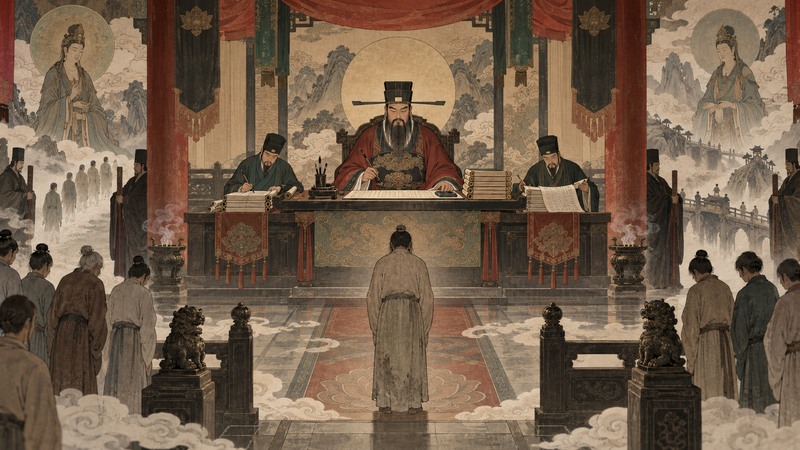
As Buddhism became established in China, Indian ideas about karma and rebirth interacted with Chinese ritual, government, family, and visual culture. One result was the influential image of the afterlife as a sequence of official courts. Records, scribes, judges, testimony, and sentencing made invisible moral judgment understandable through the institutions people knew in life.
The Met’s painting Ten Kings of Hell explains that this theme developed in the later Tang period and transformed Buddhist judgment into a distinctly Chinese bureaucratic process. In the tradition represented by that work, a soul faced successive kings at set memorial intervals before transmigration. That schedule belongs to a particular religious-artistic tradition; it should not be used as a universal timetable for all Chinese belief.
Diyu is more court system than eternal hell
Diyu (地狱) is often translated as “hell,” but that English word can suggest a single place of permanent damnation. Many Chinese Buddhist and popular accounts instead present an underworld of courts, records, punishments, correction, and onward movement. The British Museum describes Chinese hell imagery as both a place of judgment and an administrative center, with officials who review a soul’s conduct.
Yanluo Wang (阎罗王) is one of the best-known judges, while other traditions emphasize the Ten Kings. Modern films, games, novels, and online summaries often merge them into one dramatic system. Historical paintings and temple traditions can be more specific about which king, court, or memorial interval they depict.
Daoist ideas do not form one simple route either
Daoist traditions include many schools, texts, ritual systems, gods, heavens, paradises, and paths of transformation. The Met notes that Daoism developed diverse approaches over time and that Daoist, Buddhist, and Confucian traditions came to be viewed as complementary in many later settings. Their pantheons and visual languages could overlap.
This helps explain why a funerary object may combine indigenous visions of paradise with Buddhist figures. The Met’s Western Jin funerary urn, for example, joins a palatial heavenly scene with early Buddhist imagery. It is evidence of integration, not proof that everyone followed one blended doctrine.
The dead remain connected to the living
Ancestor remembrance is central to understanding why the Chinese afterlife is not only a story about distant realms. The relationship between generations can continue through grave care, household ritual, offerings, names, and family memory. UNESCO records ancestor offerings among contemporary Spring Festival practices. Qingming observances also include tending graves and remembering ancestors, as described by the Smithsonian Center for Folklife and Cultural Heritage.
| Practice | What it can express | What it does not prove |
|---|---|---|
| Grave-sweeping | Care for burial places, remembrance, and family continuity. | That every family holds identical beliefs about souls or rebirth. |
| Food, flowers, incense, or paper offerings | Respect, provision, communication, or ritual duty. | One uniform explanation for how an offering reaches the dead. |
| Memorial dates and rites | A structured relationship between living descendants and the deceased. | That all communities use the same calendar or sequence. |
| Merit-making | In Buddhist settings, beneficial acts may be dedicated to the deceased. | That ancestor rites and Buddhist rebirth are interchangeable ideas. |
How to read an afterlife story accurately
- Identify the source. Is it a tomb object, ritual manual, Buddhist painting, Daoist text, local temple story, novel, opera, or modern adaptation?
- Date the evidence. A Han tomb and a Song painting may describe different worlds because centuries of change separate them.
- Name the tradition carefully. “Chinese mythology says” is often too broad; specify Buddhist, Daoist, funerary, ancestral, literary, or popular context when possible.
- Separate art from a map. An image may teach, warn, console, or support ritual without claiming to diagram every stage literally.
- Leave room for living practice. Families and temples may preserve, reinterpret, or combine older ideas differently.
The most accurate overview is therefore plural: Chinese afterlife traditions ask how the dead continue, how moral actions matter, how families remember, and how cosmic and official order extend beyond visible life. Their answers overlap, but they are not identical.
Frequently asked questions
Is there one Chinese version of the afterlife?
No. Chinese afterlife traditions developed across long periods and combine regional custom, ancestor rites, early burial ideas, Buddhism, Daoism, and popular religion in different ways.
Is Diyu the same as an eternal hell?
Usually not. In many Buddhist and popular accounts, Diyu is a realm of judgment and correction within a larger process that can lead toward rebirth, although stories and images differ.
Does the Jade Emperor judge every dead person?
Popular stories may place the Jade Emperor above a heavenly bureaucracy, but underworld judgment is more often associated with Yanluo Wang or the Ten Kings. The roles vary across texts, temples, and retellings.
Why do families make offerings to ancestors?
Offerings can express remembrance, filial respect, and an ongoing relationship between living family members and the dead. Practice varies by family, region, and religious setting.
Enjoyed this story? Share it!
🐦 Share on Twitter📚 Related Books
Explore more Chinese mythology stories in our curated collection