Chang’e is the woman associated with the moon in Chinese mythology. Her flight begins with an elixir of immortality, but her reasons for taking it depend on the source. The moon story and the later customs of the Mid-Autumn Festival belong to related cultural traditions, rather than one account with an unchanged plot.
Chang’e’s flight in the Huainanzi
The Lanming chapter of the Huainanzi briefly relates that Yi obtains the medicine of immortality from the Queen Mother of the West. Heng’e, an early form of Chang’e’s name, steals it and flees to the moon. Yi is left bereft and cannot replenish the medicine.
The passage uses this episode within a philosophical argument about relying on a supply without understanding its source. It is a short reference, not a detailed narrative of a festival, palace, or confrontation with an intruder. That difference matters when reading a much longer modern retelling.
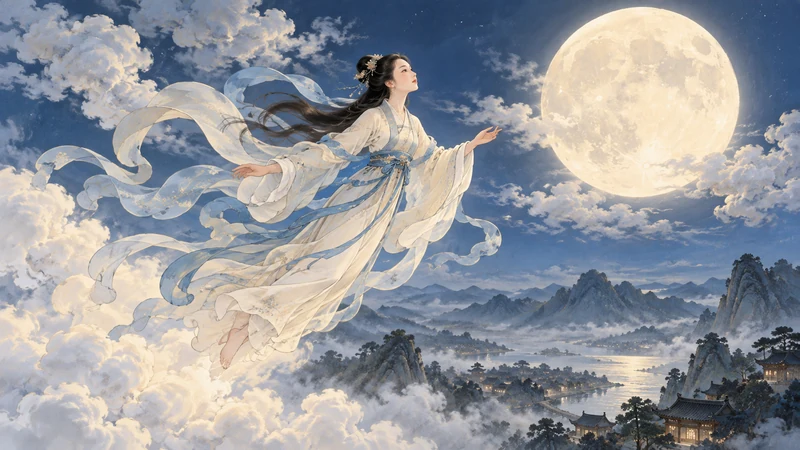
Why versions give Chang’e different motives
A modern schoolbook retelling gives the flight a protective motive. Sui Gong’s article on the Ministry of Education youth legal-education website reproduces an excerpt identified as coming from a Jiangsu Education Publishing House fifth-grade Chinese textbook. In that version, Hou Yi receives the elixir from the Queen Mother of the West and has Chang’e hide the medicine in a treasure chest. When Peng Meng threatens her and demands it, she swallows the medicine to keep it from him, then ascends to the moon. The article appeared in a 2018 magazine issue and was posted online in 2019; those dates document this retelling, not the origin of the protective-motive tradition.
Read each version on its own terms. The brief Huainanzi reference does not name Peng Meng as an attacker or explain Chang’e’s action as saving the elixir from him. An illustration of her ascent can represent the shared moon-flight motif without deciding which motive is correct for every telling.
Moon imagery and Mid-Autumn memory
The moon makes distance visible. For readers interpreting the story, Chang’e’s movement away from the earth can suggest separation, longing, and a change that cannot easily be undone. Those are readings of the narrative; they do not prove what every historical community believed.
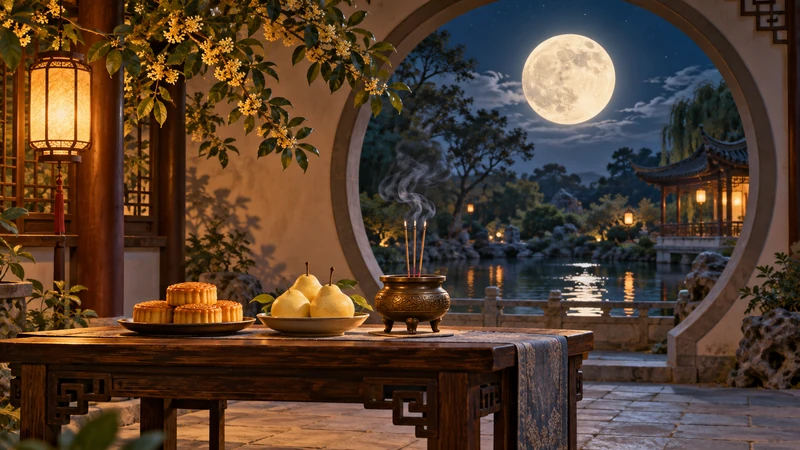
Moon offerings also have a documented cultural context. E. T. C. Werner’s 1922 account describes cakes and fruit offered to the moon at the Mid-Autumn Festival. This records a practice described by that author, rather than establishing that every family follows an identical ritual today.
Questions about the Chang’e story
Does every version say Chang’e stole the elixir?
No. The Huainanzi describes her stealing the medicine and fleeing to the moon. The modern schoolbook retelling cited here instead has her swallow it to prevent Peng Meng from seizing it.
Does a Mid-Autumn illustration document the ancient story?
No. Mooncakes, offerings, and a full moon can illustrate festival memory. They do not establish the exact events or motives of the earlier literary reference.
Related reading: Chang’e in Chinese mythology and comparing Chang’e retellings.
Enjoyed this story? Share it!
🐦 Share on Twitter📚 Related Books
Explore more Chinese mythology stories in our curated collection