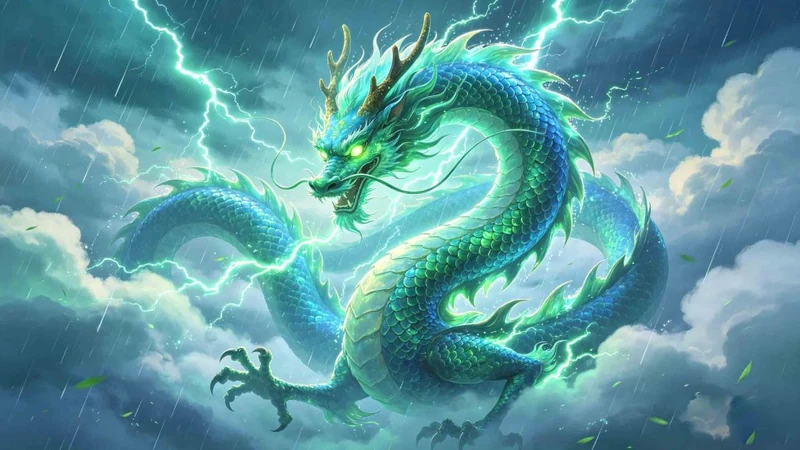
The Azure Dragon, Qinglong (青龙), is the dragon associated with the eastern direction in Chinese cosmology. Its blue-green name, spring associations and position among the Four Symbols distinguish it from dragons used more broadly as rain-bringing beings or emblems of power.
The eastern dragon and the cycle of seasons
The astronomical chapter of the Huainanzi connects the east with wood, spring and the Azure Dragon, called Canglong in that passage. These correspondences belong to a system for relating directions, seasonal change, celestial bodies and earthly life. Wood here means a phase of growth, rather than simply the material of a tree.
This makes the dragon a useful image for spring’s returning vitality. It does not establish a single biography in which Qinglong was born, ruled a sea kingdom and fought a named enemy. The figure’s identity is primarily cosmological: its meaning comes from its place in an ordered set of relationships.
How the Four Symbols fit together
The eastern dragon belongs beside the White Tiger of the west, the Vermilion Bird of the south and Xuanwu of the north. Xuanwu is conventionally represented by a tortoise and snake together; an image of a lone turtle simplifies that compound emblem. The accompanying illustration is a modern interpretation of the group.
The Book of Rites, Quli I places the bird in front, Xuanwu behind, the dragon on the left and the tiger on the right in its description of an ordered procession. Directional emblems could therefore organize terrestrial space as well as the imagined heavens. That passage does not mean every temple or palace entrance contains four separate guardian statues.

A dragon drawn across the sky
In traditional Chinese astronomy the eastern group of lunar mansions is imagined as a dragon. Its seven mansions are Horn (Jiao), Neck (Kang), Root (Di), Room (Fang), Heart (Xin), Tail (Wei) and Winnowing Basket (Ji). They form part of the twenty-eight-mansion system, rather than the twelve-animal zodiac used to name years.
The animal image gives a recognizable shape to a large region of the sky. It should not be confused with a modern constellation whose boundary has been fixed by international astronomy. Nor does a mansion’s translated name by itself establish a fortune-telling meaning such as cunning, new beginnings or stored energy.
Qinglong and other dragon images
A blue-green dragon presented with the directional guardians points specifically toward Qinglong. A dragon on a robe, vase or palace decoration may instead emphasize imperial rule, water or auspicious protection. The Metropolitan Museum’s dragon vase record documents several of these meanings and the court use of five-clawed imagery. Color alone cannot identify every dragon as the eastern guardian.
For a closer comparison, read about the White Tiger and Black Tortoise. Their directional roles help explain why the Azure Dragon belongs to a system, rather than serving as a name for all Chinese dragons.
Questions about the Azure Dragon
Is the Azure Dragon a Dragon King?
Not by default. The directional Azure Dragon and the sea-ruling Dragon Kings have different roles. A retelling may combine motifs, but that combination should be identified as the retelling’s choice.
Did Qinglong fight Gonggong?
The Huainanzi’s account of Gonggong striking Mount Buzhou does not describe a battle with Qinglong. That episode should not be presented as an established Azure Dragon legend without a specific supporting text.
Enjoyed this story? Share it!
🐦 Share on Twitter📚 Related Books
Explore more Chinese mythology stories in our curated collection