Pangu is a primordial giant in Chinese creation mythology who separates heaven and earth; in a related transformation account, his body becomes features of the natural world.
Who Was Pangu?
Pangu brings order to primordial chaos in this creation tradition.
The primordial world is described as egg-like chaos, with Pangu within it.
The account gives a span of eighteen thousand years before heaven and earth separate.
The separation account survives in fragments attributed to Xu Zheng’s Sanwu liji, associated with the Three Kingdoms period.
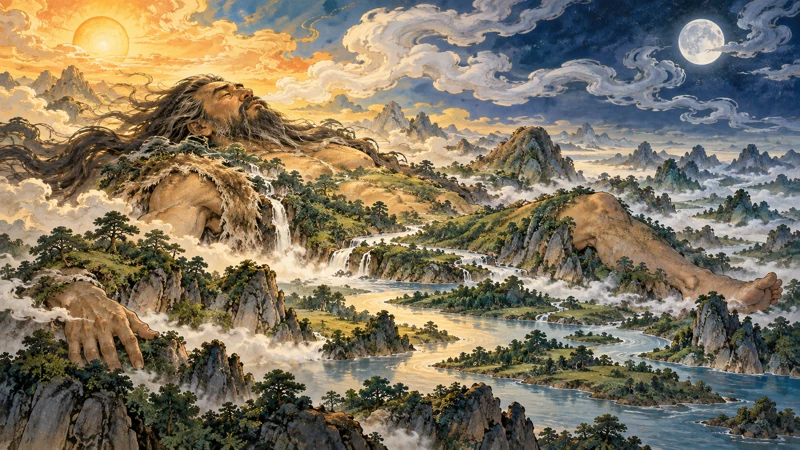
The body-transformation tradition associates his breath with wind and clouds, his voice with thunder, and his eyes with the sun and moon.
The story presents Pangu as both a separator of the cosmos and a being whose body becomes nature.
Pangu physically labored to separate heaven from earth.
He grows as the distance between heaven and earth increases.
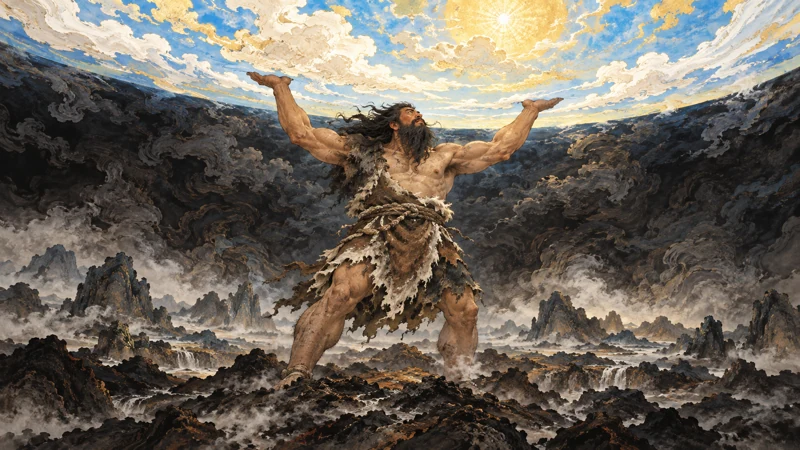
The Legendary Story of Pangu
The story begins in a time before time itself, when all existence was formless chaos.
The egg-like chaos and separation episode belongs to the Sanwu liji tradition.
The clear, light elements rise as heaven; the dense, dark elements form earth.
Pangu maintains the separation as he and the world grow.
The account then gives another eighteen thousand years of growth.
The body-transformation account continues with Pangu’s death.
His breath becomes wind and clouds, his voice thunder, his eyes the sun and moon, and his blood rivers.
In the body-transformation tradition, his bones become minerals, his body hair vegetation, and his sweat rain.
The Deeper Meaning Behind Pangu
The following readings interpret the myth rather than identify its original author’s intention.
The story offers an image of order emerging from chaos.
Its immense timescale can be read as an image of patience and perseverance.
The body-transformation motif can suggest interconnection between a creator and the natural world.
Pangu did not disappear; he became everything. His death was not an ending but a transformation.
A modern ecological reading also finds significance in the myth.
Pangu’s body becomes rivers, mountains, forests and sky.
This allows a reader to imagine nature as sacred.
Related reading: Chinese Mythology Nuwa · Chinese Mythology Nezha · Chinese Mythology Tattoo Ideas · Wikipedia
Pangu in Modern Culture
Modern retellings can reinterpret the creation story. Their details should be identified separately from the early fragments cited above.
Frequently Asked Questions
Which text records Pangu separating heaven and earth?
The account survives in fragments attributed to Xu Zheng’s Sanwu liji, associated with the Three Kingdoms period.
How does Pangu’s body become the world?
In the body-transformation tradition, his breath, voice, eyes and blood become wind, thunder, the sun and moon, and rivers.
Does this account require a god-given axe?
The cited early separation fragment describes cosmic separation and growth without a god-given axe.
Enjoyed this story? Share it!
🐦 Share on Twitter📚 Related Books
Explore more Chinese mythology stories in our curated collection