Readers searching for erlang shen chinese mythology story usually need a clear figure profile, not a single forced biography. Erlang Shen is recognizable because of the third eye, martial authority, transformation scenes, and celestial hound, but those details change as stories move between local worship, literature, opera, and modern retellings.
Quick Answer
Erlang Shen, often written 二郎神 (Èrláng Shén), is a powerful divine or semi-divine figure associated in many Chinese stories with martial skill, transformation, perception, and the ability to confront dangerous beings. He is commonly shown with a third eye and a skilled celestial hound, but the details of his family background, rank, and adventures vary by source. A useful way to read him is as a figure whose authority is demonstrated through disciplined action rather than through one fixed biography.
Basic Facts
The name and the figure
“Erlang” means “second young lord” or “second son” in a title-like form, while shen means deity or spirit. The name does not by itself identify one complete character history. Stories, local traditions, religious texts, performance traditions, and popular literature have contributed different layers to the figure.
Readers may encounter Erlang Shen as a heavenly general, a regional water-control hero, a relative of a powerful goddess, or a rival and ally of other famous figures. These versions should be compared rather than silently merged.
Erlang Shen Chinese Mythology Story: Core Symbols
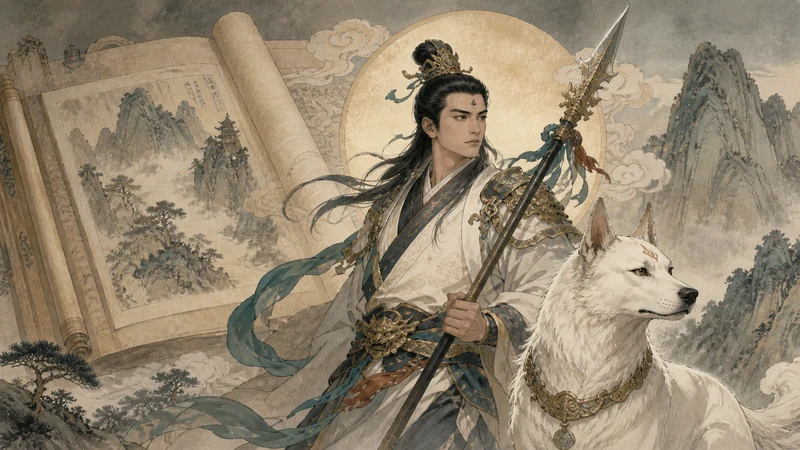
The third eye is the most recognizable symbol. In story terms, it suggests perception that reaches beyond ordinary appearances: seeing through disguise, recognizing a demon, or detecting a hidden truth. It should not be reduced to a modern superpower label. Its meaning depends on the narrative in which it appears.
The celestial hound, often called Xiaotian Quan in later popular retellings, represents loyalty and ferocity under command. The hound’s presence also gives combat scenes a partnership structure: Erlang Shen is not simply a solitary warrior, but a strategist who works with a trained companion.

His weapon and transforming abilities vary in depiction. They support a recurring image of adaptability, yet the exact weapon, number of transformations, or scene order should be tied to a named source before being presented as fact.
Stories readers often meet
One major group of stories presents Erlang Shen in conflict with a dangerous or rebellious figure. He may track, challenge, or capture an opponent whose transformations test his perception. These episodes highlight tactical intelligence: seeing through a disguise matters as much as physical strength.
Another group connects him to water control, mountain landscapes, or local hero traditions. In these accounts, the figure’s importance is linked to practical protection and the management of forces that threaten communities. Such stories can explain why later audiences read him as both a martial deity and a guardian.
Popular retellings may connect him to the narrative world of Journey to the West, where his changing forms, third eye, and combat skill make him a memorable opponent or ally. A novel, opera, animation, or game can adapt these features without preserving every earlier religious or literary association.
For a neutral background source, compare the figure with a general Erlang Shen overview, then verify specific episodes against their own source tradition.
Why retellings differ
Chinese mythology does not function as one closed canon with one authorized character sheet. A deity can accumulate stories across regions, genres, and centuries. A temple tradition may emphasize protection, a novel may emphasize family conflict, and a game may emphasize combat abilities. Each is a retelling with its own goals.
When comparing versions, ask three questions: What source or genre is this? Which relationships are central in this version? Which symbols remain, and which have been newly emphasized? This approach avoids calling one adaptation “the true myth” while still describing recurring patterns.
Reading the figure responsibly
Use phrases such as “in many popular retellings,” “in the novel tradition,” or “some local traditions associate him with…” when the evidence is varied. Avoid presenting modern character designs as ancient source evidence. Likewise, do not turn a mythic figure into a verified historical person.
The most stable takeaway is thematic: Erlang Shen represents skilled perception, disciplined force, and the testing of appearances. The details around that theme should remain attached to their source and context.
For erlang shen chinese mythology story, version control is the core reading habit. A temple note, a novel episode, and a modern animation may all preserve recognizable symbols while arranging relationships and scenes differently.
A careful erlang shen chinese mythology story note should name the source layer before naming a detail as fixed. That keeps the third eye, hound, and transformation scenes connected to evidence rather than to a blended character sheet.
Readers can compare erlang shen chinese mythology story versions by asking whether the passage emphasizes protection, combat, family conflict, water control, or a test of appearances. The answer changes the way each symbol should be explained.
The safest summary for erlang shen chinese mythology story is modest: Erlang Shen often represents disciplined perception and force, but specific family ties, ranks, weapons, and scene order need an attributed source.
A classroom using erlang shen chinese mythology story can separate recurring symbols from variable plot details. Students can mark the third eye and hound as common signals while leaving source-specific claims attached to their retelling.
Modern adaptations can make erlang shen chinese mythology story visually memorable, but their designs should not be treated as proof of earlier religious or literary tradition. The article keeps that boundary visible.
A final erlang shen chinese mythology story review should confirm name, role, symbol, story source, and version boundary. If those five items are clear, the reader can continue without merging unrelated traditions.
Another useful erlang shen chinese mythology story check is to separate identity from episode. Identity covers the name Erlang Shen, the third eye, the hound, martial perception, and divine authority; episode covers the particular conflict or test in one retelling.
When a source gives Yang Jian, a heaven official, a local protective figure, or a literary opponent, the erlang shen chinese mythology story explanation should preserve that source label. Mixing labels without context makes the story easier to remember but harder to verify.
The article therefore treats erlang shen chinese mythology story as a source-aware profile. It helps a reader recognize the figure in different books, temple settings, classroom summaries, and modern references while keeping uncertain details out of the quick answer.
For searchers comparing erlang shen chinese mythology story versions, the practical rule is simple: keep recurring symbols in the main note, place source-specific plot points in the version note, and avoid turning one adaptation into a universal biography.
A stronger erlang shen chinese mythology story reading also checks what the story is trying to do for its audience. Some tellings stress a sharp judge who sees through disguise, some stress a heroic fighter, and some stress local protection. Those purposes explain why the same figure can feel different without being unrelated.
If a reader saves notes from this erlang shen chinese mythology story, the best record is a compact table: source, symbol, role, uncertain detail, and what still needs verification. That table prevents the third eye, hound, weapon, and family details from becoming unsupported claims.
For wider context, compare Erlang Shen with the Chinese mythology stories hub, related Chinese gods and deities, and other Chinese mythology stories.
Quick reference
Frequently Asked Questions
Who is Erlang Shen?
Erlang Shen is a prominent divine or semi-divine figure in Chinese stories, often associated with a third eye, martial skill, transformation, and a celestial hound.
What does Erlang Shen's third eye symbolize?
It commonly represents extraordinary perception, such as seeing through disguise or recognizing hidden danger. Its exact role depends on the source.
Is Erlang Shen the same in every Chinese myth?
No. Religious, local, literary, opera, and modern popular traditions present different relationships, ranks, and adventures.
Does Erlang Shen appear in Journey to the West?
He appears in popular retellings connected with the novel tradition, but a modern adaptation may alter his role, powers, or relationships. Identify the version being discussed.
Is Erlang Shen a historical person?
He is a mythic and religious-cultural figure, not a person whose story should be presented as verified history.
Enjoyed this story? Share it!
🐦 Share on Twitter📚 Related Books
Explore more Chinese mythology stories in our curated collection