Nezha’s story in Fengshen Yanyi moves from an extraordinary birth to conflict with the Dragon King, the loss of his first body, and a new body made from lotus flowers and leaves. His father Li Jing and teacher Taiyi Zhenren are central to this sequence. Birth and lotus restoration are separate events.
Fengshen Yanyi is a Ming-period novel set against the fall of the Shang and rise of the Zhou, weaving supernatural characters into that dynastic conflict.
A child born at Chentang Pass
Chapter 12 introduces Li Jing, his wife Lady Yin, and their sons. After a pregnancy lasting three years and six months, Lady Yin gives birth to a ball of flesh. Li Jing cuts it open and a child emerges, already carrying the golden Universe Ring and red sash.
Taiyi Zhenren visits, names the child Nezha, and accepts him as a disciple. The chapter later places the seven-year-old child beside the water, where his actions provoke a confrontation with the Dragon King’s forces and Ao Bing. The lotus is not the object from which he is first born in this version.
Death, a temple, and a lotus body
The confrontation grows into a crisis involving his family. Chapter 13 recounts his giving up his body; the following chapter continues the story of his spirit. This is a violent episode, so a retelling for young children can summarize the loss without graphic detail.
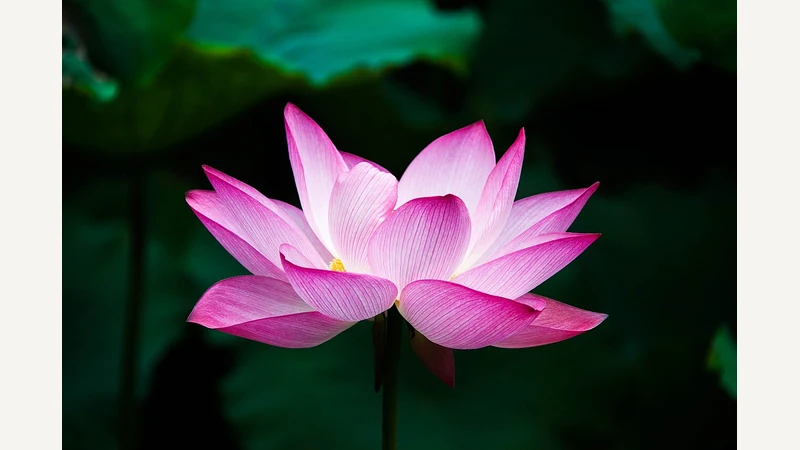
In chapter 14, Lady Yin has a temple built for Nezha. Li Jing destroys its image and burns the temple. Nezha returns to Taiyi Zhenren, who makes a new body using lotus flowers, lotus leaves, and a golden pill. The illustration below depicts this restoration, rather than his birth.

The weapons identify the restored Nezha
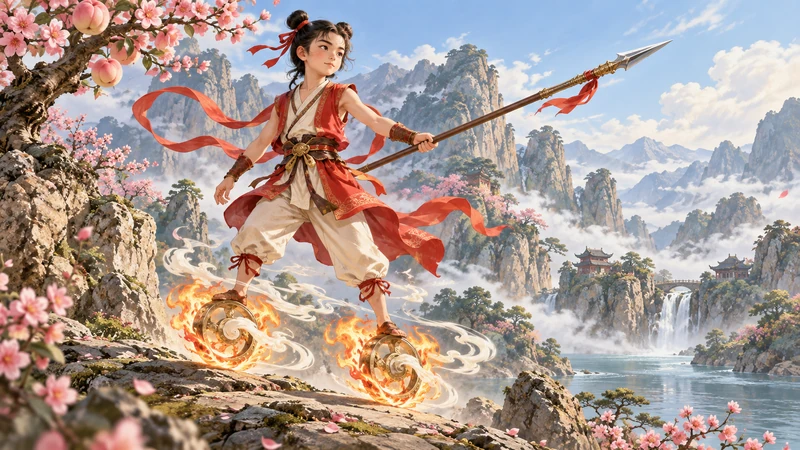
Taiyi trains the restored Nezha with the fire-tipped spear and gives him the Wind-Fire Wheels. The same passage also lists the Universe Ring, red sash, and a golden brick placed in his bag. These objects help identify this particular literary and artistic figure.
The wind and fire wheels allow him to travel rapidly in the story. A lotus under the figure can recall his reconstructed body, but a lotus flower by itself cannot establish that an image depicts Nezha. A useful identification combines the figure, objects, and the source being illustrated.
The conflict with Li Jing continues
Restoration does not immediately resolve the father-son conflict. Nezha pursues Li Jing to avenge the destruction of his temple. Mu Zha, his second brother, confronts him, and other powerful figures intervene. The novel’s family relationships are more complicated than a simple account of an obedient child rewarded for good behavior.
At the end of chapter 14, Ran Deng traps Nezha in a fiery pagoda and compels him to acknowledge Li Jing as his father. Nezha bows and speaks obediently under threat, but the narrator says he remains resentful. Ran Deng then gives Li Jing the pagoda to restrain further attacks. The episode ends in enforced submission rather than sincere reconciliation.
Readers can interpret the episode through obligation, anger, dependence, and the difficulty of reconciliation. Those interpretations should remain connected to what the chapter actually depicts. A modern adaptation can change Nezha’s motives or relationships while borrowing his lotus and weapons.
Questions about Nezha
Was Nezha born from a lotus flower?
In Fengshen Yanyi, he first emerges from a ball of flesh in chapter 12. Taiyi Zhenren makes his lotus body later, in chapter 14.
Is Taiyi Zhenren the same character as Li Jing?
No. Taiyi is Nezha’s teacher in this account; Li Jing is his father. Their roles are distinct in the birth, temple, and restoration episodes.
Does Nezha sincerely reconcile with Li Jing in chapter 14?
No. Ran Deng uses a fiery pagoda to force Nezha to acknowledge his father. Nezha outwardly submits but remains resentful, and Li Jing receives the pagoda to restrain him.
Related reading: Nezha in Chinese mythology.
Enjoyed this story? Share it!
🐦 Share on Twitter📚 Related Books
Explore more Chinese mythology stories in our curated collection