Chinese mythology Kunlun Mountain stands as one of the most revered and mystical realms in ancient Chinese folklore, far more than a simple geographic location—it is a symbol of the divine, immortality, and the boundary between the mortal and spiritual worlds. For centuries, it has captivated storytellers, philosophers, and ordinary people, serving as a backdrop for tales of gods, heroes, and the pursuit of eternal life.
Unlike Mount Olympus in Greek mythology, which is tied to a specific pantheon, Kunlun is a universal axis mundi, connecting heaven, earth, and the underworld in Chinese cosmology. It is not just a place but a concept that shapes how Chinese culture understands spirituality, virtue, and the relationship between humans and the divine.
Many readers new to Chinese mythology might wonder why Kunlun matters so deeply. For the ancient Chinese, Chinese Mythology Kunlun Mountain it was believed to be the center of the world, the point where the heavens descended to earth, and where the most powerful deities resided.
Its stories are not just fantasy—they reflect ancient values: that immortality is not a reward for power alone, but for moral purity, and that the divine is accessible to those who respect natural order. This balance of wonder and wisdom is what makes Kunlun a timeless subject, even for modern audiences who encounter it through games, films, and translated texts.
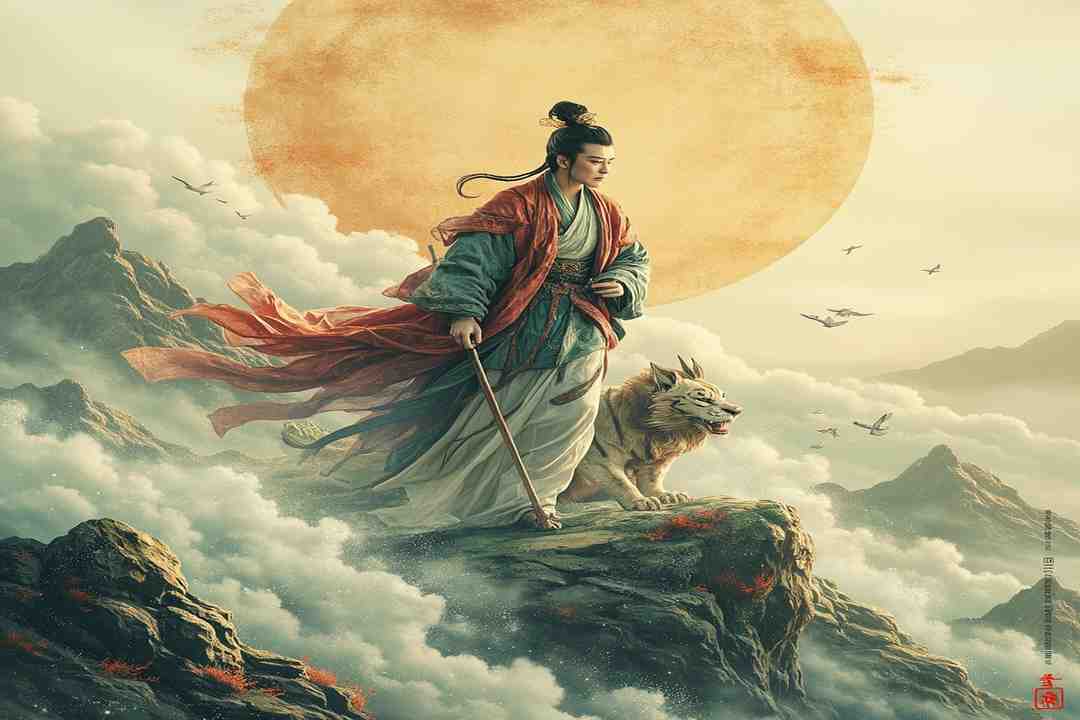
Who Was Chinese Mythology Kunlun Mountain?
Chinese mythology Kunlun Mountain is best defined as a sacred spiritual realm, not a physical peak—though real mountain ranges in western China (the Kunlun Mountains) likely inspired its mythic core. The earliest written descriptions appear in the *Shan Hai Jing* (Classic of Mountains and Seas), a 4th-century BCE text that catalogs mythic lands and creatures.
According to this source, Kunlun is a towering mountain with jade palaces, golden terraces, and nine gates guarded by divine beasts like the white tiger (Bai Hu), a symbol of protection and justice.
At the heart of Kunlun’s identity is its primary resident: the Queen Mother of the West (Xi Wang Mu), Chinese Mythology Kunlun Mountain a powerful goddess of immortality, magic, and fate. Unlike Western depictions of goddesses, Xi Wang Mu is a complex figure—she is both a keeper of eternal life and a judge of souls, whose domain on Kunlun is off-limits to those with selfish motives.
The *Huainanzi*, a 2nd-century BCE philosophical text, adds that Kunlun is home to the Peaches of Immortality, which ripen every 3,000 years; only those with unblemished virtue can partake of them.
A common misconception is that Kunlun is a place of endless indulgence. In reality, it is a realm of order and discipline.
The *Shan Hai Jing* describes it as having a “heavenly well” that feeds the Yellow River, linking it to the lifeblood of Chinese civilization. This connection to water—essential for survival—reinforces Kunlun’s role as a source of balance between the divine and the mortal, not just a playground for gods.
For beginners to Chinese mythology, focusing on Xi Wang Mu’s role as a guardian of virtue is a great entry point, as it avoids the confusion of overly complex mythic details while capturing Kunlun’s core meaning.

The Story Behind Chinese Mythology Kunlun Mountain
One of the most concrete tales tied to Chinese mythology Kunlun Mountain is the story of Yu the Great and the Great Flood. Yu, a legendary hero tasked with ending a catastrophic flood that had devastated ancient China, traveled to Kunlun to seek help from the divine.
According to the *Shan Hai Jing*, he approached the god of the Yellow River, who resided on Kunlun’s slopes, and received a “Golden Book of the River”—a scroll of maps and instructions that allowed Yu to redirect floodwaters into the sea, rather than trying to contain them with dams. This story is not just about a hero’s success; it ties Kunlun to the idea that divine wisdom is necessary for solving humanity’s greatest challenges.
Another vivid narrative involves Emperor Wu of the Han Dynasty, a ruler obsessed with immortality. Legend holds that Wu, who reigned from 141 to 87 BCE, climbed to Kunlun’s peaks to meet Xi Wang Mu.
The goddess greeted him, but when he begged for a peach of immortality, she only gave him one. Xi Wang Mu explained that mortals who seek immortality for power or personal gain are unworthy—Wu’s single peach was a warning that immortality is not a reward for ambition, but for humility.
This story has been retold in countless Chinese operas and novels, making it one of the most accessible Kunlun tales for modern audiences.
A third lesser-known story comes from the *Sou Shen Ji* (Record of the Grand Historian), Chinese Mythology Kunlun Mountain a 4th-century CE collection of ghost and god tales. It tells of a mortal named Chang’e, who stole a pill of immortality from her husband Hou Yi and fled to the moon—but before that, she visited Kunlun to ask Xi Wang Mu for the pill.
This links two of China’s most beloved myths (Chang’e’s moon exile and Hou Yi’s archery) to Kunlun, showing how the realm acts as a hub connecting different parts of Chinese folklore. Each of these stories has been adapted over centuries, but their core about virtue and divine order remains unchanged.
What Chinese Mythology Kunlun Mountain Means in Chinese Culture
Chinese mythology Kunlun Mountain is a symbol of immortality, but it also represents moral purity. The jade that is said to cover Kunlun’s peaks is believed to have healing properties, and drinking from its heavenly springs grants longevity.
This ties to ancient Chinese beliefs that nature is divine, and that pure, unspoiled places hold spiritual power. For traditional Chinese culture, Kunlun is not just a myth—it is a reminder that humans should live in harmony with nature, not dominate it.
Rituals tied to Kunlun have shaped Chinese history for millennia. Ancient emperors would hold sacrifices at mountain peaks, Chinese Mythology Kunlun Mountain including those near the real Kunlun ranges, to honor the divine realm and seek the “Mandate of Heaven”—the right to rule.
These sacrifices involved offerings of silk, jade, and livestock, and they were meant to connect the mortal emperor to the divine order of Kunlun. This practice reflects how myths are not just stories; they influence real-world behavior, from political power to religious rituals.
Another key meaning of Kunlun is its role as a marker of cultural identity. For Chinese people, Kunlun is a shared reference point, appearing in poems, paintings, and folk songs.
The Tang Dynasty poet Li Bai wrote about Kunlun in his works, using it to express longing for the divine and escape from worldly troubles. This cultural significance means that even today, when Chinese people hear the name Kunlun, they immediately associate it with their heritage—something that is rare for most mythic realms.
Why Chinese Mythology Kunlun Mountain Still Matters Today
Chinese mythology Kunlun Mountain has found new life in modern media, introducing it to global audiences. The popular video game *Genshin Impact* features the Liyue region, whose architecture and deities draw heavily from Kunlun’s design: the Jade Palace in Liyue Harbor is a direct nod to Kunlun’s golden terraces, and the goddess Guizhong (a minor figure in the game) is based on Xi Wang Mu’s divine servants.
As of 2024, Genshin Impact has over 50 million monthly players, many of whom have become curious about Kunlun’s original myths after encountering it in the game.
In education, Kunlun stories are a staple in Chinese primary school curricula, teaching children about their cultural heritage. Western translations of the *Shan Hai Jing*, including Kunlun’s tales, are now available in bookstores and online, helping foreign readers understand Chinese mythology beyond the famous Monkey King stories.
For example, the 2022 translation of *Classic of Mountains and Seas* by Anne Birrell includes detailed notes on Kunlun, making it accessible to English-speaking students and scholars.
Beyond media and education, Chinese Mythology Kunlun Mountain Kunlun has become a symbol of resilience and mystery in global culture. Chinese brands like Kunlun Energy use the name to evoke strength and longevity, while fantasy novels like *The Poppy War* reference Kunlun’s divine order to add depth to their worldbuilding.
This modern relevance shows that Kunlun is not just an ancient myth—it is a living concept that continues to adapt to new contexts, connecting past wisdom to present-day curiosity.
Frequently Asked Questions
What is the origin of Chinese mythology Kunlun Mountain?
The origin of Kunlun Mountain in Chinese mythology traces back to ancient Warring States-era texts like the *Classic of Mountains and Seas* and *Huainanzi*. It emerged from early Chinese cosmological beliefs that framed it as an axis mundi—a sacred mountain connecting heaven and earth, located in the far west of the mythic world. It was also revered as a primordial source of major rivers, including the Yellow River, blending pre-Shamanic spiritual ideas and early philosophical concepts of sacred geography.
What are the main characters in Chinese mythology Kunlun Mountain?
Key figures in Kunlun Mountain mythology include the Queen Mother of the West (Xi Wang Mu), the primary deity residing at its peak, who guards the peaches of immortality and the elixir of eternal life. Other important characters are her celestial attendants (jade maidens and immortal beings), the great flood hero Yu the Great, who visited Kunlun to seek divine aid in taming catastrophic floods, and guardian spirits like the White Tiger, which protects the mountain from evil forces.
What is the moral lesson of Chinese mythology Kunlun Mountain?
The cultural and moral lessons of Kunlun Mountain mythology center on spiritual purity, virtue, and alignment with the cosmic order. As a symbol of the highest realm of transcendence, it teaches that access to divine wisdom, immortality, or cosmic power is reserved for those with selfless intentions (such as heroes working for the common good, like Yu the Great) rather than those driven by selfish desire. It also emphasizes respect for the sanctity of nature and the spiritual dimensions of the world.
How is Chinese mythology Kunlun Mountain celebrated in modern China?
In modern China, Kunlun Mountain is honored through cultural, tourism, and religious channels. It is a core symbol in contemporary Chinese fantasy, literature, and media, featuring widely in xianxia (immortal hero) novels, films, and TV series that draw on traditional mythic themes. The real Kunlun Mountain range in western China (spanning Qinghai and Xinjiang) is a popular tourist and pilgrimage site, visited by Taoist practitioners and cultural enthusiasts alike. It is also promoted as a key intangible cultural heritage element, with events like the annual Kunlun Cultural Festival held to showcase its historical and mythic significance.
What are similar myths to Chinese mythology Kunlun Mountain?
Similar myths within Chinese mythology include those of other sacred cosmic realms. Mount Penglai, a mythical island in the East China Sea, shares Kunlun’s association with immortality and transcendence, framing it as a place where immortals reside. Mount Tai, China’s eastern sacred mountain, also functions as a cosmic axis linking the mortal and divine worlds, mirroring Kunlun’s role as a central sacred space. Additionally, myths of the Peach Garden of the Queen Mother of the West—located on Kunlun—are closely related, depicting a parallel realm of eternal bliss and divine bounty.
What Chinese Mythology Feng Shui Means in Chinese Mythology Chinese Mythology Wealth God: 7 Legends, Origins & Cultural Chinese Mythology Sea Goddess Uncovered: 7 Surprising Facts Wikipedia
Enjoyed this story? Share it!
🐦 Share on Twitter📚 Related Books
Explore more Chinese mythology stories in our curated collection