When a child in Shanghai decorates their home with red paper cuts of birds ahead of Lunar New Year, or a scholar studies the 2nd-century stone carvings in Shandong’s Wu Family Shrines, they are touching a thread of Chinese mythology that stretches back millennia: the chinese mythology vermilion bird. This creature is not just a mythical bird—it is one of the Four Symbols that anchor the ancient Chinese cosmos, linking heaven, earth, and human life through its color, direction, and elemental power.
Many Western readers first encounter the vermilion bird through its cousin, the phoenix, but the two are distinct: the Chinese vermilion bird is a fixed symbol of the south, summer, and fire, while the phoenix is a more general symbol of renewal and good fortune. Understanding this difference is key to unlocking its role in Chinese culture, from religious rituals to modern pop culture.
Who Was Chinese Mythology Vermilion Bird?
The vermilion bird (called Zhu Que in Mandarin) is formally known as one of the Four Symbols (Sishou), Chinese Mythology Vermilion Bird along with the Azure Dragon (east, spring, wood), White Tiger (west, autumn, metal), and Black Tortoise (north, winter, water). Each symbol represents a direction, season, element, and celestial region, forming a framework that ancient Chinese astronomers used to map the night sky.
The vermilion bird governs the southern quadrant of the sky, which contains 28 lunar mansions grouped into seven stars that form its shape. For beginners to Chinese mythology, starting with the Four Symbols (including the vermilion bird) is a safe entry point, as they are widely referenced in art and literature across Chinese history.
You can learn more about another key symbol in this group in our article on the Azure Dragon.
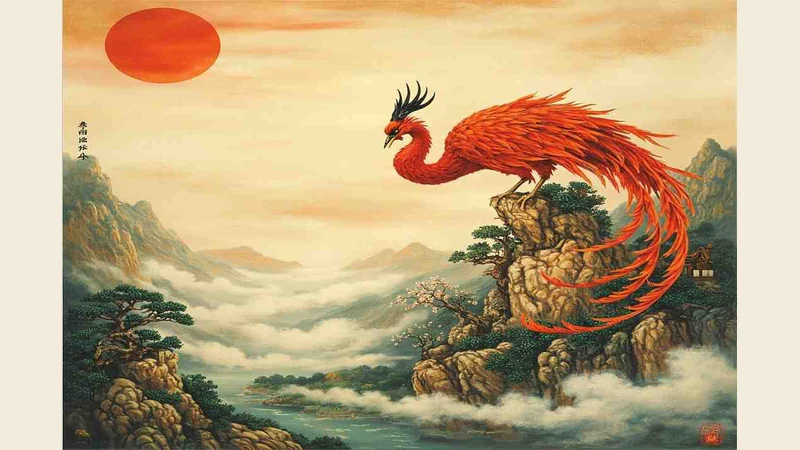
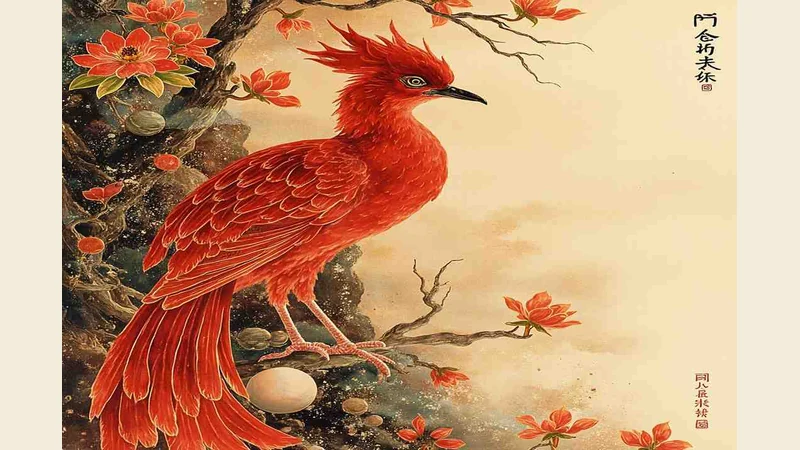
In the Classic of Mountains and Seas (Shanhai Jing), a 4th-century BCE text that compiles ancient myths and geographical lore, the vermilion bird is described as having a crimson body, golden beak, white head, and black eyes. It is often depicted with wings spread wide, holding a scroll or a pearl in its claws—symbols of wisdom and divine authority.
Unlike the phoenix, which is said to appear only during times of peace, the vermilion bird is a constant presence in the celestial order, a guardian of the south that maintains balance in the cosmos. This distinction is critical to avoiding common misconceptions among new readers of Chinese mythology.
Archaeological evidence confirms its early importance: the Wu Family Shrines in Jiaxiang, Chinese Mythology Vermilion Bird Shandong, built during the Eastern Han Dynasty (25–220 CE), feature detailed stone carvings of the four symbols, including the vermilion bird perched on a cloud, its feathers rendered with fine lines that show the artisans’ skill. These carvings were not just decorative—they served as protective amulets, placed to ward off evil and bring good fortune to the family who commissioned them.
The shrine’s carvings are one of the most complete surviving depictions of the Four Symbols from ancient China, offering a tangible link to the beliefs of the time.
The Story Behind Chinese Mythology Vermilion Bird
The core story of the vermilion bird is tied to its role as a celestial guardian, but it also appears in myths about the gods. One tale from the Han Dynasty describes how the Yellow Emperor (Huangdi), the legendary ancestor of the Chinese people, assigned each of the Four Symbols to guard a direction of his palace.
The vermilion bird was chosen to watch over the southern gate, as its fiery color matched the sun’s path in the south, which was the direction of warmth and growth. The Yellow Emperor’s decision was not arbitrary: in ancient Chinese cosmology, the south was associated with the element of fire, which was essential for cooking, warmth, and agriculture—so the vermilion bird’s role was to protect these vital aspects of human life.
Another story comes from the Chu Ci, Chinese Mythology Vermilion Bird a collection of ancient poems from the Warring States period (475–221 BCE). In the poem “Li Sao,” the poet Qu Yuan describes a journey to the heavens, where he meets the vermilion bird, which acts as a messenger between the mortal world and the gods.
Qu Yuan asks the bird to carry a message to the goddess Nüwa, asking for guidance on his exile. The bird agrees, showing its role as a bridge between human desires and divine will.
This story highlights the bird’s association with communication and spiritual connection, making it a symbol of hope for those seeking divine help.
A lesser-known tale tells of the vermilion bird’s battle against a nine-headed sea monster that terrorized the southern coast of ancient China. The monster, which breathed poison and destroyed crops, killed dozens of villagers each month.
The vermilion bird, acting on the orders of the Jade Emperor, descended to earth and fought the monster for three days. Using its fiery feathers, it burned the monster’s heads one by one, finally defeating it and saving the remaining villagers.
This story is still told in southern China during the Dragon Boat Festival, where small paper cutouts of the vermilion bird are placed on boats to symbolize protection from evil spirits.
What Chinese Mythology Vermilion Bird Means in Chinese Culture
The vermilion bird’s symbolism is deeply rooted in the five elements (wuxing) system of ancient Chinese philosophy: it represents fire, Chinese Mythology Vermilion Bird which corresponds to the south, summer, and the color vermilion (a bright red that is associated with luck in Chinese culture). Unlike Western symbols of fire, which can be destructive, the Chinese vermilion bird’s fire is creative—it fuels growth, warmth, and transformation.
This is why during Lunar New Year, red decorations (including those featuring the vermilion bird) are used to welcome good fortune and ward off bad luck. The color red itself is not just a random choice; it is directly tied to the bird’s identity and its role in bringing positive energy.
In traditional Chinese medicine, the vermilion bird is linked to the heart, which is considered the seat of the soul and emotion. The color red, which the bird embodies, is believed to balance the heart’s energy, promoting health and vitality.
For this reason, many traditional remedies and rituals use red items, such as red threads or amulets with the vermilion bird, to treat heart-related ailments or bring emotional stability. This connection shows how mythology is not just a story, but a practical part of daily life in traditional Chinese culture.
It is a reminder that ancient beliefs were integrated into every aspect of human survival and well-being.
The vermilion bird also symbolizes loyalty and honor, Chinese Mythology Vermilion Bird traits that are highly valued in Chinese society. In ancient times, generals would carry banners with the vermilion bird’s image into battle, as it was believed to bring courage and victory.
This symbolism is still present today: many Chinese companies use the vermilion bird in their logos to represent strength and reliability. For example, a major Chinese airline uses a stylized red bird in its branding, tying its business to the ancient symbol of protection and success.
This continuity shows that the vermilion bird’s meaning has evolved but remained central to Chinese values.
Why Chinese Mythology Vermilion Bird Still Matters Today
In modern pop culture, the vermilion bird appears in many forms, from video games to movies. One notable example is the popular game Genshin Impact, where the character Hu Tao, a funeral director, uses a weapon called the “Staff of Homa” that features a vermilion bird design.
This choice is deliberate: Hu Tao’s role involves balancing life and death, which aligns with the vermilion bird’s association with fire and transformation. The game’s developers have stated that they drew inspiration from Chinese mythology when creating the character, introducing millions of global players to the vermilion bird’s symbolism.
This kind of adaptation helps keep ancient myths relevant for younger, global audiences.
The vermilion bird also plays a role in modern education, Chinese Mythology Vermilion Bird especially in programs that teach Chinese culture to overseas children. For example, our website chinamythstories.com uses stories of the Four Symbols, including the vermilion bird, to help children understand ancient Chinese cosmology in a fun, engaging way.
These programs often include activities like drawing the vermilion bird or making paper cuts, which help children connect with the symbolism on a personal level. For many children, this is their first introduction to Chinese mythology, and the vermilion bird is a memorable, colorful entry point.
The vermilion bird’s role in Lunar New Year traditions aligns with other festive symbols, such as the Chinese New Year dragon, which you can read about here: [Chinese New Year Dragon: A Symbol of Good Fortune].
In recent years, there has been a growing interest in traditional Chinese art and design, and the vermilion bird is a popular motif in fashion, home decor, and even architecture. For example, a luxury fashion brand recently released a collection of dresses featuring the vermilion bird, using its bright red color and intricate feather patterns to appeal to consumers looking for cultural authenticity.
This trend shows that the vermilion bird remains relevant as a symbol of Chinese identity, bridging the gap between ancient traditions and modern life. It is no longer just a mythical creature—it is a cultural icon that resonates with people around the world.
Frequently Asked Questions
What is the origin of chinese mythology vermilion bird?
The Vermilion Bird (known as Zhu Que in Chinese mythology) traces its origins to ancient Chinese astronomical observations of the southern celestial constellations, with roots dating back to the Shang Dynasty (c. 1600–1046 BCE). It evolved from stellar mythology, later becoming one of the Four Symbols (Siling)—divine guardians of the four cardinal directions—aligned with the Five Elements (Wu Xing) as the symbol of fire, the south, summer, and yang energy.
What are the main characters in chinese mythology vermilion bird?
The primary central character is the Vermilion Bird (Zhu Que), a majestic, powerful divine bird deity associated with solar and fiery energy. Key related mythic figures include the Yellow Emperor (Huangdi), who is mythologized as summoning the Four Symbols (including Zhu Que) to assist in establishing cosmic order and winning battles, and the Sun Goddess Xihe, as Zhu Que is linked to solar vitality.
What is the moral lesson of chinese mythology vermilion bird?
The core moral lesson emphasizes the importance of maintaining cosmic and social harmony, aligning human actions with natural cycles (such as seasons and cardinal directions), and upholding righteous protection against chaos. The Vermilion Bird symbolizes the balance of opposing forces (like yin-yang and fire-water) and the responsibility of individuals to foster order in both their communities and the broader universe.
How is chinese mythology vermilion bird celebrated in modern China?
In modern China, the Vermilion Bird is celebrated through various cultural practices and contemporary expressions. It is featured in Lunar New Year decorations, especially in southern regions, where its vivid red image is used to attract good fortune and repel negative energy. It is also tied to summer festivals like the Dragon Boat Festival, as it represents the summer season and solar strength. Additionally, Zhu Que appears frequently in modern Chinese pop culture, including fantasy TV dramas, video games, and comics, often as a formidable divine guardian character.
What are similar myths to chinese mythology vermilion bird?
Similar myths include those of the other Three Celestial Symbols of Chinese mythology: the Azure Dragon (east, wood), White Tiger (west, metal), and Black Tortoise (north, water), which collectively form the cosmic guardians of the four directions. Another closely related myth is that of the Jin Wu, the three-legged sun crow, a solar deity often paired with or conflated with the Vermilion Bird due to their shared association with fire and the sun.
7 Fascinating Facts About Chinese Mythology Nuwa That Will C 7 Fascinating Facts About Chinese Mythology Chang E That Wil 7 Fascinating Facts About Chinese Mythology Book That Will C Wikipedia
Quick Answer and Evidence Check
Chinese Mythology Vermilion Bird Explained is easiest to evaluate by separating the direct definition, the practical context, and the evidence used to support the conclusion.
Basic Facts
- Primary topic: Chinese Mythology Vermilion Bird Explained
- Best check: confirm the definition, example, and usage boundary agree.
- Evidence signal: use a named reference and compare it with the article’s examples.
Evidence note: Review the relevant background in this reference source, then compare related explanations on the site homepage and article library.
Quick reference: Chinese Mythology Vermilion Bird Explained = direct answer + factual summary + cited evidence + practical boundary.
Reader Checks
What should a reader verify first?
Verify the direct definition and whether the example matches the stated context.
Why include an evidence check?
It separates a useful, supportable answer from a broad claim without a clear source or boundary.
Enjoyed this story? Share it!
🐦 Share on Twitter📚 Related Books
Explore more Chinese mythology stories in our curated collection