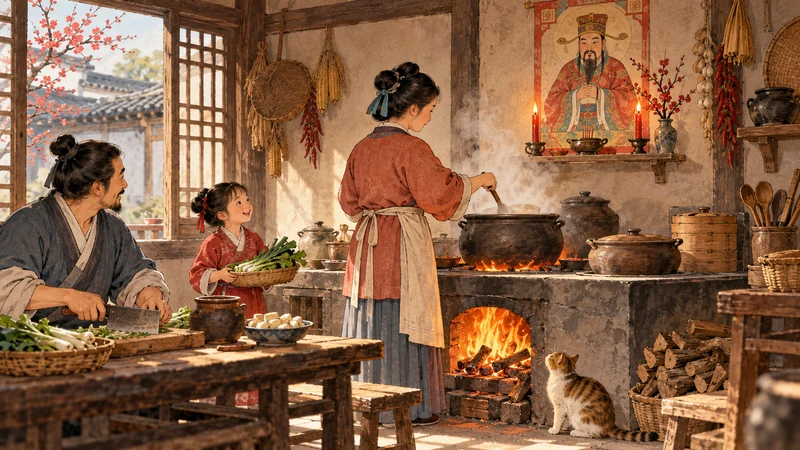
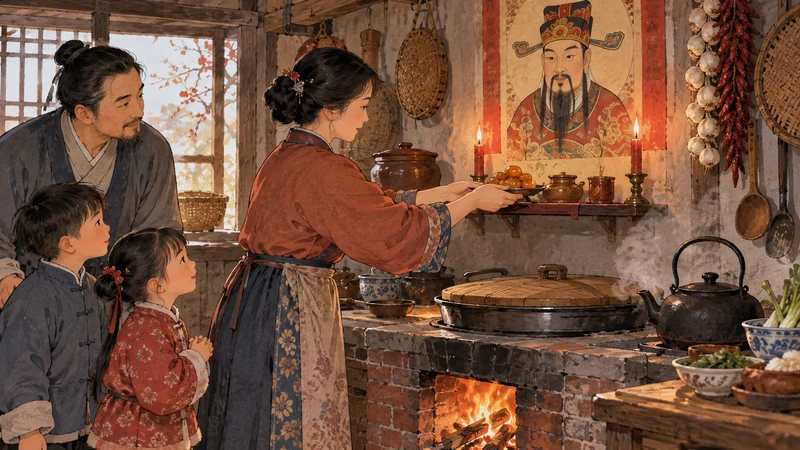
The Chinese mythology kitchen god, known in Chinese folk tradition as Zao Shen, is one of the most enduring and relatable deities in Chinese culture, woven into daily life, customs, and even idiomatic expressions that capture core values of household accountability and attention to detail. For millennia, this figure has been more than a mythical being; he is a quiet observer of family life, a keeper of secrets, and a symbol of the idea that no action— no matter how small— goes unseen.
His presence in Chinese society spans ancient texts, seasonal festivals, and everyday speech, making him a central part of how people understand domestic integrity and community.

The Story Behind chinese mythology kitchen god
The roots of the Chinese mythology kitchen god stretch back to the earliest recorded history of Chinese civilization, with references found in one of the oldest texts of Chinese ritual, the *Liji* (Book of Rites), compiled during the Western Zhou Dynasty (1046–771 BCE). In this ancient text, he is listed as one of the five “household gods,” along with deities of the door, well, bed, and hearth— each tasked with protecting a critical part of a family’s daily life.
Over centuries, his role evolved from a minor guardian to a more prominent figure, as texts like the Han Dynasty’s *Huainanzi* (2nd century BCE) expanded his duties to include reporting the deeds of each household to the Jade Emperor, the supreme ruler of the Taoist pantheon.
The most widely known legend of the Kitchen God’s origin comes from folk tales that date to the Tang Dynasty (618–907 CE): a man named Zhang Lang, once wealthy and arrogant, abandoned his elderly wife, who had cared for him through years of hardship, to marry a younger, more attractive woman. Years later, Zhang lost his fortune, his new wife left him, and he was reduced to begging on the streets.
One day, he encountered his ex-wife, who had become a respected healer. Ashamed of his past actions, Zhang hid in the family’s kitchen to avoid her, only to slip and fall into a boiling cauldron of water, dying instantly.
Moved by his final act of remorse— choosing to hide in the kitchen, the heart of his old family— the Jade Emperor granted Zhang a new life as the Kitchen God, tasked with watching over every household and reporting their deeds once a year. This legend established two key traits of the Kitchen God: his role as a judge of human actions and his connection to the space that nourishes families, making him a beloved yet revered figure in Chinese culture.
What chinese mythology kitchen god Really Means
While the term “Chinese mythology kitchen god” is not a traditional four-character chengyu (the formal type of Chinese idiom), it has evolved into a widely used cultural idiomatic expression in both Chinese and English, carrying a meaning that extends far beyond the mythical figure himself. At its core, the idiom refers to two interconnected ideas: first, the concept of constant, unobserved oversight of household actions, and second, a person who possesses exceptional attention to detail, especially in domestic or group settings.
The Kitchen God’s annual report to the Jade Emperor means that every small act— from a child sneaking cookies before dinner to a family member lying about their whereabouts— is documented, shaping the household’s fortune for the coming year. In modern usage, this idiom is often applied to people: a friend who notices when you’re upset before anyone else, a colleague who catches typos and errors others miss, or a roommate who cleans up the mess you left without being asked.
It also carries a moral weight, reminding people that their actions have consequences, even when no one else is watching. Unlike more formal idioms, this term is flexible, used in casual conversation, cultural discussions, and even business settings to describe someone with a keen eye for detail.
How to Use chinese mythology kitchen god in Conversation
Using the idiom “Chinese mythology kitchen god” in conversation is straightforward, as it is often used to describe a person with the traits of the mythical figure— attention to detail, awareness of hidden actions, and care for domestic spaces. Below are four practical, natural examples of how to use it in everyday speech:
- When describing a trusted roommate or friend: “My flatmate Mia is the Chinese mythology kitchen god of our apartment. She noticed I was skipping meals last week and left a bowl of soup on my desk without me asking.”
- When talking about a meticulous colleague: “Our project manager is like the Chinese mythology kitchen god— she caught a missing data point that would have cost our client thousands of dollars, something the rest of us overlooked.”
- When referencing a folk custom or family saying: “My grandma always says the Chinese mythology kitchen god sees everything, so I never leave my toys scattered on the kitchen table when she visits.”
- When discussing a group trip or event: “During our camping trip, my cousin was the Chinese mythology kitchen god of the group. She packed extra band-aids, remembered everyone’s allergy to nuts, and even found a lost water bottle in the woods at midnight.”
These examples show how versatile the idiom is, adapting to different contexts while staying true to its core meaning of keen awareness and attention to detail.
Why chinese mythology kitchen god Matters Today
The Chinese mythology kitchen god and the idiom associated with him remain relevant today for several reasons, reflecting timeless values that resonate across cultures. First, in an era of busy lives and digital communication, the idiom’s emphasis on noticing small, unspoken acts reminds people to be present in their relationships.
Too often, we overlook the small details— a friend’s sadness, a colleague’s hard work, a family member’s struggle— but the Kitchen God’s legacy encourages us to slow down and pay attention.
Second, the idiom’s connection to household integrity is particularly important in modern society, where many people live in shared spaces, work in remote teams, or are part of large communities. The idea of being a “Kitchen God” means taking responsibility for your actions, being accountable to the people around you, and respecting the spaces you share.
Third, the idiom is a bridge between cultures, allowing people to learn about Chinese folk traditions and values in a relatable way. For non-Chinese speakers, using this idiom is a way to reference a beloved cultural figure without needing to understand complex Chinese texts or language.
Finally, the Kitchen God’s role as a reporter to a higher power reminds us that our actions have consequences, even when we don’t see them immediately— a message that is as relevant today as it was thousands of years ago.
Related Idioms
The Chinese mythology kitchen god is closely linked to several other Chinese idioms and folk sayings that share themes of attention to detail, domestic life, and accountability. These related phrases help deepen the understanding of the Kitchen God’s legacy:
- *Shi Mi Bu Lou* (粒米不漏): A classic four-character chengyu meaning “not a single grain of rice missed.” This idiom is used to describe someone who is extremely meticulous and thorough in their work, a trait that aligns perfectly with the Kitchen God’s role as an observer of every small action. For example, one might say, “The new accountant is shi mi bu lou, just like the Chinese mythology kitchen god.”
- *Zao Shang You Shen Ming* (灶上有神明): Literally translating to “there is a god above the stove,” this is a common folk saying that directly references the Kitchen God. It is used to remind people that their actions in the kitchen (and household) are witnessed, Chinese Mythology Kitchen God carrying the same moral weight as the idiom.
- For instance, a parent might say to their child, “Don’t sneak candies— zao shang you shen ming, you know.”
- *Jia Wu Xiao Shi* (家务小事): Meaning “small household matters,” this phrase highlights the domain that the Chinese mythology kitchen god oversees. It emphasizes that even the smallest domestic tasks— cooking, cleaning, caring for family— are important and worthy of attention, a core value reflected in the Kitchen God’s role.

Frequently Asked Questions
Is the Chinese mythology kitchen god a formal idiom?
No, while it is not a traditional four-character chengyu (the formal type of Chinese idiom), it has evolved into a widely recognized idiomatic expression in cross-cultural contexts. Chinese Mythology Kitchen God It is used more in casual and cultural discussions than in formal academic or professional writing.
When is the Kitchen God honored in Chinese culture?
The annual festival to honor and send off the Kitchen God falls on the 23rd or 24th day of the 12th lunar month, typically in late January or early February, just before Lunar New Year. Families offer sticky rice cakes or sweets to the Kitchen God to make his mouth sticky, so he only speaks good things about their household when he reports to the Jade Emperor.
Are there different versions of the Kitchen God’s legend?
Yes, regional variations exist across China. Chinese Mythology Kitchen God In some southern provinces, the Kitchen God is depicted as a woman, the wife of the original deity, while other stories focus on different figures, such as a loyal servant or a filial son, who became the Kitchen God for their good deeds.
What is a common mistake learners make with this idiom?
A frequent error is conflating the Chinese mythology kitchen god with the God of Wealth (Cai Shen), another prominent Chinese deity. For example, a learner might say, “We hung a picture of the Chinese mythology kitchen god to bring us good luck and money.” This is incorrect because the Kitchen God’s role is to report household deeds, not grant financial prosperity— that is the domain of Cai Shen.
Another mistake is using it to describe a gossip, when it actually refers to accountability and attention to detail.
One Last Thing
The Chinese mythology kitchen god is more than just a mythological figure or a casual idiom— it is a reflection of the values that have held Chinese families together for millennia. In a world that often prioritizes big achievements and grand gestures, the Kitchen God reminds us that the small, daily acts of care, responsibility, and attention to detail are what make a home, a community, and a life meaningful.
Whether you use it to describe a friend who always has your back, a colleague who catches mistakes, or simply to reference a beloved cultural tradition, this idiom carries a timeless message: what happens in our homes, in our daily lives, matters. As we navigate the complexities of modern life, the wisdom of the Chinese mythology kitchen god remains as relevant as ever, encouraging us to be present, accountable, and kind in every moment.

Chinese Mythology Creation Story Chinese Mythology Movie Chinese Mythology Book Wikipedia
Frequently Asked Questions
What is the origin of chinese mythology kitchen god?
The origin of the Chinese Kitchen God (Zaoshen) traces back to ancient Chinese folk beliefs, with roots in the Shang Dynasty (c. 1600–1046 BCE) when the hearth was revered as a sacred center of the household. Early myths often depict him as a mortal man named Zhang Lang who died in a kitchen fire, transformed into a deity by the Jade Emperor to oversee household affairs. Over time, he evolved into a divine figure tasked with recording the daily good and bad deeds of each family, reporting his observations to the Jade Emperor annually.
What are the main characters in chinese mythology kitchen god?
The primary central figure is the Kitchen God (Zaoshen), a revered domestic deity who monitors household activities. Most traditions also include his wife, the Kitchen Goddess (Zaoshen Niangniang), who assists in maintaining household harmony and kitchen order. In some regional variations, there may be minor attendant deities, but the core pair is universally recognized for their roles as guardians and record-keepers of family conduct.
What is the moral lesson of chinese mythology kitchen god?
The key moral lessons of the Kitchen God myth emphasize accountability for everyday actions, even those in private household spaces. It teaches that consistent virtuous behavior (kindness, honesty, and family unity) is observed by divine beings, not just public deeds. The tradition of offering sweet foods to the Kitchen God also reinforces the value of truth—by making his mouth sticky, families hope he will report only their good deeds, reflecting that integrity secures blessings and prosperity.
How is chinese mythology kitchen god celebrated in modern China?
Modern celebrations of the Kitchen God (called Xiaonian, or “Minor New Year”) fall on the 23rd or 24th day of the 12th lunar month, marking the start of Spring Festival preparations. Contemporary practices include offering sweets (rice cakes, candies) to encourage the Kitchen God to speak well of the family, burning his paper effigy to send him to the Jade Emperor in heaven, and later welcoming him back with a new paper image. Urban and rural families clean their kitchens thoroughly during this time, symbolizing cleansing the old to prepare for his return and the new year. Diaspora Chinese communities (e.g., in Taiwan, Singapore) also uphold these rituals as a cultural heritage link.
What are similar myths to chinese mythology kitchen god?
Similar myths in Chinese mythology include those of the Earth God (Tudigong), a local guardian deity overseeing villages or neighborhoods who reports human deeds to the celestial court—mirroring the Kitchen God’s role as a mediator between humans and higher powers. Another parallel is the Door God (Menshen), who protects households from misfortune, just as the Kitchen God safeguards domestic well-being. Additionally, the Well God (Jingshen), a minor deity tied to household water sources, shares the theme of being a domestic-focused guardian venerated for meeting daily life’s needs.
Enjoyed this story? Share it!
🐦 Share on Twitter📚 Related Books
Explore more Chinese mythology stories in our curated collection