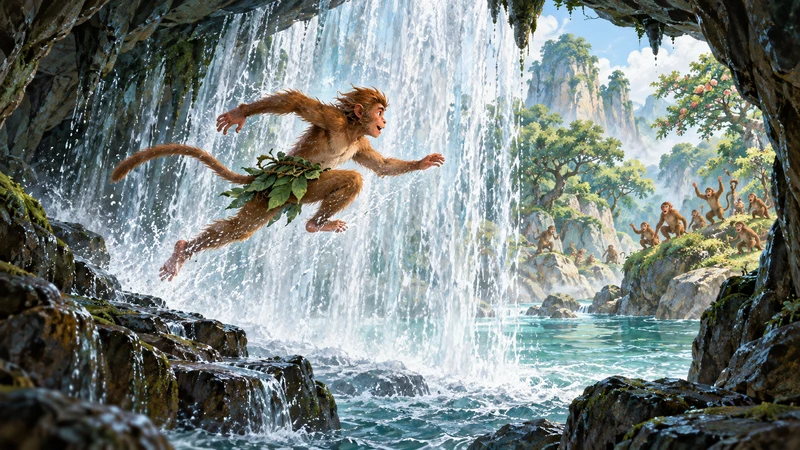
Sun Wukong is the Monkey King in Chinese mythology and the classic novel Journey to the West: a rebellious stone-born monkey who learns immortal arts and later protects the pilgrim Tang Sanzang.
He battles Heaven’s forces and later develops from a troublemaking trickster into a committed protector.
His story, told in the classic novel Journey to the West, has captivated readers for centuries.
This is a tale of courage, cunning, and the eternal struggle between individual freedom and cosmic order.
Who Was Sun Wukong?
Sun Wukong, also known as the Monkey King or Great Sage Equal to Heaven, was born from a magical stone egg on the Flower-Fruit Mountain.
According to chapter one of Journey to the West,
he emerged fully formed—a monkey of strange appearance who immediately showed extraordinary intelligence.
He quickly became king of the monkeys by showing bravery in entering a waterfall cave—the Water Curtain Cave that would become his home.
His true power came from seeking out Patriarch Subhuti, who taught him arts of longevity and transformation.
He learned 72 transformations and the Cloud Somersault technique, described as covering 108,000 li in one somersault.
These magical abilities made him a formidable opponent.
What made Sun Wukong truly unique was his magical weapon—the Ruyi Jingu Bang (or Golden Staff).
In chapter 3, he obtains it from Ao Guang, Dragon King of the East Sea. The object had served as a measure for the waters in the account of Yu controlling the floods.
The staff can shrink to needle size or grow much larger; its inscription states a weight of 13,500 jin.
Sun Wukong carried it in his ear, transforming it at will.
The Legendary Story of Sun Wukong
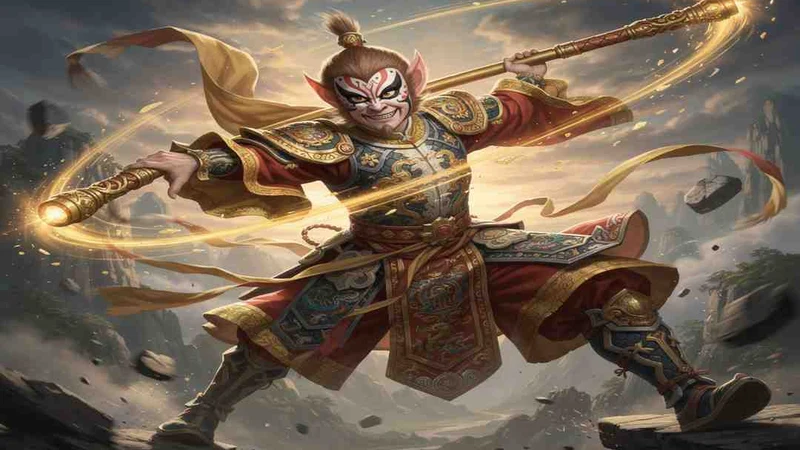
His conflict with Heaven escalates after he is appointed keeper of the heavenly horses. On discovering the post has no official rank, he leaves Heaven and adopts the title Great Sage Equal to Heaven.
The heavens send armies to capture him.
He fights Heaven’s forces with magical transformations and hairs that become additional fighters.
Erlang confronts him in a prolonged contest; with assistance that includes Laozi’s thrown ring, the heavenly forces capture Wukong.
His rebellion ends when the Buddha intervenes. The Buddha makes a wager: if Sun Wukong can escape his palm, he can rule Heaven.
The monkey leaps to the edge of the world, sees five pillars, and marks them as proof of his journey.
But these pillars are merely fingers on the Buddha’s hand.
The novel describes Wukong imprisoned beneath the Five Elements Mountain for five hundred years before Tang Sanzang frees him. Chapter 14 recounts their meeting.
The Deeper Meaning Behind Sun Wukong
Ancient Chinese storytellers wove profound philosophy into this action tale.
Sun Wukong represents the eternal human struggle against limitation—his rebellion symbolizes the desire to transcend boundaries imposed by authority.
His imprisonment and eventual redemption suggest that even the most rebellious spirit must find harmony with greater cosmic order.
His transformation from selfish rebel to protective disciple reflects Buddhist teachings about transcending ego.
Accompanying Tang Sanzang on the journey to retrieve Buddhist scriptures from India represents the path toward enlightenment.
The pilgrims’ trials become lessons in patience, humility, and moral strength.
Confucian values appear too—the importance of social harmony and proper conduct.
Sun Wukong must learn that individual brilliance serves no purpose without discipline and loyalty to one’s companions.
His devotion to Tang Sanzang, despite frequent misunderstandings, shows the reward of faithful service.
Sun Wukong in Modern Culture
Sun Wukong continues to inspire adaptations in different media.
Black Myth: Wukong is a 2024 action role-playing game based on Journey to the West, not a 2023 film.
Netflix’s The Monkey King is a 2023 animated family film whose cast includes Jimmy O. Yang and Bowen Yang.
The earlier animated film Havoc in Heaven (1961) adapts episodes of Wukong’s rebellion, providing another version to compare with the novel.
How to Experience Sun Wukong Today
Read chapter 1 for his stone birth and the Water Curtain Cave, then compare the novel with a modern adaptation. Keep details invented by an adaptation separate from the original episode.
At the Journey’s End
At the end of the pilgrimage, Wukong receives the title Victorious Fighting Buddha. This is the novel’s conclusion to his transformation from rebel to committed protector, not evidence that he began as an alternate manifestation of the Buddha. Read chapter 100.
Related reading: Chinese Mythology Chang E; Chinese Mythology Pangu; Chinese Mythology Nuwa; Wikipedia
Frequently Asked Questions
What is Sun Wukong’s most surprising ability?
His 72 transformations and magical hairs allow him to change form and produce additional fighters. Chapter 3 also has him erase names in the monkeys’ register of life and death; he does not free every condemned soul.
Why is Sun Wukong imprisoned?
Buddha ends his rebellion by trapping him beneath the Five Elements Mountain. The novel describes a long imprisonment before his pilgrimage; it does not explain it by a historical decline of Buddhism in India.
Does Sun Wukong achieve Buddhahood?
Yes. Chapter 100 grants him the title Victorious Fighting Buddha at the pilgrimage’s end.
What is the Ruyi Jingu Bang’s weight?
Chapter 3 gives the staff’s inscribed weight as 13,500 jin. It can change size; converting that traditional literary unit to a fixed modern tonnage is unnecessary.
Does Sun Wukong defeat Erlang?
Their encounter ends with Wukong captured by the heavenly forces after assistance including Laozi’s ring. The novel does not offer a single definitive ranking of his enemies.
Enjoyed this story? Share it!
🐦 Share on Twitter📚 Related Books
Explore more Chinese mythology stories in our curated collection